Winning the Narrative and the Grid: 2026 U.S. AI Sentiment, Adversary Information Operations, and the Strategic Cost of an American AI Slowdown
"America does not suffer from a shortage of private capital, scientific talent, or foundational silicon—it suffers from a widening misalignment between the architects of artificial intelligence and the citizens asked to host its power plants and absorb its labor transitions." — ThinkForge Strategic Intelligence Briefing, Q4 2026
EDITORIAL & EPISTEMIC CALIBRATION NOTICE: This dossier synthesizes 2025–2026 probability-sample opinion research (Pew Research Center, Gallup/Bentley, Microsoft-Gallup, Ipsos, Edelman, Quinnipiac, Stanford HAI), grid-market telemetry (PJM Independent Market Monitor, EIA, LBNL), infrastructure opposition trackers (Data Center Watch, Ballotpedia, Moratorium Nation), and threat-intelligence disclosures (Alethea, DFRLab, OpenAI, Google Threat Intelligence Group, Graphika, Clemson Media Forensics Hub). Survey and market figures are REPORTED FACT and carry inline primary-source citations. The 2027–2035 GDP and federal-revenue forfeiture figures in §5.1 are an explicitly labeled SCENARIO MODEL—a transparent sensitivity calculation, not a forecast. Foreign information operations are documented as amplifiers of authentic domestic grievances; this dossier makes no claim that they decisively moved U.S. voter behavior.
Cross-Dossier Architecture Mapping: This dossier maps the public-legitimacy and narrative-security layer of American AI competitiveness. For national compute and export-control doctrine, see The Sovereign AI State: How Nations Are Weaponizing Artificial Intelligence Policy. For high-voltage interconnect and grid baseload architecture, see Sovereign Compute Grids & High-Voltage Interconnect Diplomacy and The Transformed Grid 2040. For the defense-industrial consequences of frontier-AI velocity, see The New Arsenal: Software Primes, Autonomous Platforms, and the Retooled Defense Industrial Base.
00. Transmission Header#
CLASSIFICATION : Tresslers Group Intelligence // ThinkForge Division // Field Dossier 26.11
DOMAIN         : Public Legitimacy / Narrative Security / Grid Siting / U.S.–PRC AI Competition
STATUS         : Active Strategic Intelligence — Verified Benchmark v1.1
AUDIT STANDARD : Probability-Sample Survey, Market-Monitor & Threat-Intel Primary Source Grounding
RESEARCH CUT   : 2026.11.22 UTC (Fixed Analytical Snapshot)
DATE           : 2026-11-22
LAST_SYNC      : 2026.11.22
AGENTIC_DELTA  : 91% (Narrative-Grid Coupling & Diffusion Velocity Index)
TPM_V1         : Conviction 9.4 // Strategic Impact 9.8 // Maturity 8.9 // Risk 9.3
ALERT LEVEL    : Tier-1 Strategic Assessment — Domestic Legitimacy Deficit & Adversary Amplification
ONTOLOGY NODE  : AI Diffusion Paradox (TREG-AI-DIFFUSION-PARADOX-2026)
 Figure 0: Narrative interference across the American compute grid — data-center lattice, transmission corridors, and adversary signal noise
Key Strategic Signals#
| Metric | Empirical Benchmark | Operational Significance | Primary Source Reference |
|---|---|---|---|
| 74% | AI-aware Americans reporting worry about AI | #1 in worry among 37 countries surveyed; only 36% expect AI to mostly help the U.S. (vs. 93% in China). | Microsoft-Gallup, Sep 2026 [6] |
| 52% vs. 9% | U.S. adults "more concerned than excited" vs. "more excited" | Negative-to-positive ratio widened from ~2:1 (2021) to >5:1 (June 2026). | Pew Research Center [8] |
| $354B | U.S. data center projects blocked or delayed (2025–H1 2026) | $156B (2025) + $130B (Q1 2026) + $68B (Q2 2026); 843 opposition groups across 49 states. | Data Center Watch [19] |
| $29.4B | PJM wholesale capacity costs attributed to data center load | Four Base Residual Auctions; December 2026 auction risks a further $5B–$10B. | PJM Independent Market Monitor [22] |
| 40 / 41 | Local data center ballot measures won by restriction side | November 3, 2026; registered-voter opposition to nearby data centers reached 75%. | Ballotpedia / Heatmap-Embold [19] |
| 37 → ~40,000 | Russian Pravda-network articles in Common Crawl (Nov 2024 → Nov 2025) | >1,000-fold growth; as few as 250 poisoned documents can compromise large LLMs. | Atlantic Council DFRLab [29] |
| 2.7% | U.S.–China frontier model gap on Chatbot Arena (March 2026) | Frontier lead is now narrow; diffusion, energy, and price determine the contest. | Stanford HAI AI Index 2026 [21] |
| $3.04T–$5.24T | Cumulative 2027–2035 U.S. GDP forfeited under a 40% slowdown drag (central OECD–IMF band) | SCENARIO MODEL — full range $0.60T–$9.50T; $525B–$906B in foregone federal revenue (central band). | Tresslers Group sensitivity model [25] |
Executive Brief#
The United States enters late 2026 in an acute strategic paradox: it remains the world's premier engine of frontier artificial intelligence creation—commanding $285.9 billion in 2025 private AI investment (more than 23 times China's reported $12.4 billion private total, though excluding Beijing's massive state guidance funds), $764 billion (Goldman Sachs estimate) to $820 billion (corporate guidance tracked by Brookings) in projected 2026 hyperscaler capital expenditure, and 59 notable AI models released in 2025 versus China's 35 [1]—yet its public has become the most anxious and skeptical toward AI of any major nation on Earth [6]. Across five 2026 U.S. probability-sample surveys synthesized by Our World in Data, negative public sentiment toward AI's societal impact consistently outweighs positive sentiment, reaching a negative-to-positive ratio of more than five-to-one in Pew Research Center's June 2026 poll [7]. Simultaneously, 74% of AI-aware Americans report feeling worried about AI—ranking first in worry among 37 countries surveyed by Microsoft and Gallup—and 71% oppose constructing an AI data center in their own community, exceeding local opposition to nuclear power plants by 18 percentage points [6]. By contrast, 85% of respondents in China say AI offers more benefits than drawbacks (Ipsos, March–April 2026) and 93% expect AI to mostly help their country (Microsoft-Gallup, September 2026) [6]. Meanwhile, according to Microsoft's telemetry-adjusted Q2 2026 Global AI Diffusion Report, U.S. working-age generative AI usage ranks just 21st globally at 33.0%, trailing the United Arab Emirates (73.3%), Singapore (64.3%), Ireland (49.9%), France (49.6%), the United Kingdom (43.7%), and South Korea (40.6%) [11].
For Tresslers Group—a diversified holding company engineering planetary-scale systems across AI, strategic commerce, precision longevity, and sovereign intelligence infrastructure [14]—this collapse in domestic confidence is not a peripheral communications issue; it is an immediate operational threat to American industrial velocity and national power. Across 2025 and the first half of 2026, Data Center Watch (a tracker from 10a Labs) tallied $354 billion in disclosed U.S. data center project value blocked or delayed amid local opposition ($156 billion in 2025 plus $198 billion in H1 2026, encompassing both temporary pauses and cancellations) [19]. On November 3, 2026, voters backed restrictions in 40 of 41 local data center ballot measures tracked by Ballotpedia, while a 50-state statutory tracker recorded 156 state AI laws enacted across 38 states during 2025–2026 amid congressional stalemate on federal preemption [19]. Crucially, this backlash reflects a volatile convergence of genuine, solvable domestic friction—most visibly $29.4 billion in PJM wholesale electricity capacity costs across four auctions, opaque local siting, and a nearly 20% drop in employment among software developers aged 22 to 25 since 2024 [21]—compounded by grossly exaggerated technical myths (such as viral water-usage claims inflated 33-fold to 1,923-fold over empirical prompt measurements [24]), self-inflicted Silicon Valley "doomerism" [8], and documented Chinese, Russian, and Iranian media amplification and LLM training-data poisoning [27].
An honest, pro-America strategy cannot dismiss organic voter grievances as foreign plots; independent threat analysts confirm that hostile states are exploiting an existing domestic fire rather than starting it [30]. Equally, however, America cannot afford a unilateral slowdown. Stanford HAI's 2026 AI Index documents that the frontier model gap between the United States and China narrowed to just 2.7% on the Chatbot Arena leaderboard by March 2026 [21], while Beijing couples open-weight price commoditization (one-sixth the commercial token price of U.S. offerings) [33], more than double U.S. electricity output [33], mandatory industrial diffusion ("AI Plus") [34], embodied robotics [35], and new Global South governance blocs (WAICO and the World Data Organization) [36]. At the same time, state and criminal cyber actors have crossed an autonomous multi-agent offense threshold, with Google Threat Intelligence documenting zero-day exploits spiking to 22 in August 2026 alone—double the January–July 2026 monthly average [38]. In an illustrative sensitivity model calibrated to major institutional productivity forecasts over 2027–2035, a sustained 40% domestic slowdown drag would forfeit $0.60 trillion to $9.50 trillion in cumulative U.S. GDP—clustering between $3.04 trillion and $5.24 trillion under central OECD and IMF benchmarks—alongside $525 billion to $906 billion in foregone federal tax revenues [25]. Reclaiming public trust, fixing grid rate design, unifying federal standards, and hardening America's AI substrate are therefore urgent prerequisites for preserving American technological leadership through 2035.
1. The 2026 Global AI Sentiment Divide: Why America Leads in Creation but Trails in Confidence#
Global public opinion toward artificial intelligence in 2026 has split sharply along regional, institutional, and socioeconomic lines. Worldwide sentiment remains cautiously constructive: in the March–April 2026 Ipsos AI Monitor (23,532 adults under age 75 across 32 countries), 55% agreed that AI products and services offer more benefits than drawbacks [10], and in the September 2026 Microsoft-Gallup AI Adoption Survey across 37 nations, positive emotions toward AI outweighed negative emotions in 34 of 37 countries [6]. The United States stands out at the pessimistic extreme of that global distribution.
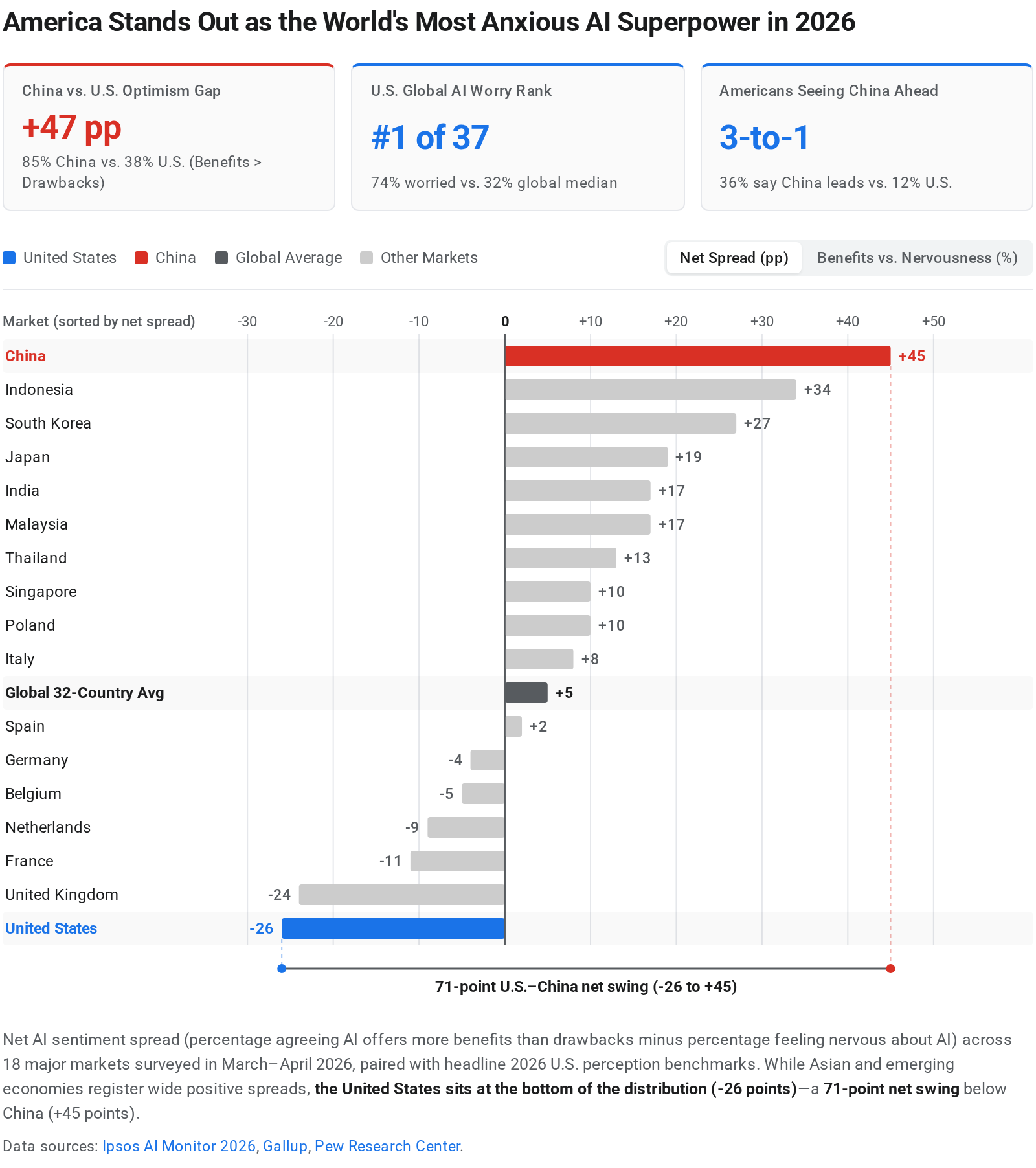 Figure 1: America Stands Out as the World's Most Anxious AI Superpower in 2026 — Net AI sentiment spread (-26 U.S. vs. +45 China, a 71-point net swing), U.S. #1 of 37 worry rank (74%), and 3-to-1 China lead perception (Ipsos AI Monitor 2026, Gallup, Pew Research Center)
Every major 2026 cross-national tracker confirms the same stark divide. In Ipsos's March–April 2026 survey, 85% of Chinese respondents, 80% of Indian respondents, 77% of Indonesians, 68% of Singaporeans, and 67% of South Koreans agreed that AI offers more benefits than drawbacks; in the United States, just 38% agreed—matching the United Kingdom (38%), France (38%), and the Netherlands (38%), and sitting barely above Germany (37%) among the major Western markets reported [10]. Simultaneously, 64% of Americans reported feeling nervous about AI products and services, compared with 40% in China and South Korea and 31% in Japan [10]. That produces a 47-percentage-point U.S.–China optimism gap, a 24-point nervousness gap, and a 71-point swing in net sentiment [25]. Microsoft and Gallup's September 2026 survey reveals an even wider divergence on national trajectory: 93% of AI-aware adults in China, 91% in Vietnam, 77% in Singapore, and 69% in Israel expect AI to mostly help their country, compared with just 36% in the United States—ranking third-lowest among all 37 countries, ahead only of Bangladesh (34%) and Egypt (35%) [6]. Notably, the United States is one of only three countries surveyed (alongside Egypt and the Palestinian Territories) where positive emotions toward AI do not outnumber negative emotions [6].
| Economy | Benefits > Drawbacks (Ipsos, Apr 2026) | Nervous About AI (Ipsos, Apr 2026) | AI Mostly Helps Country (Gallup, Sep 2026) | Trust in AI (Edelman, Nov 2025) | Fear Being Left Behind by GenAI, Low/High Inc. (Edelman, 2026) | Working-Age AI Diffusion & Global Rank (Microsoft, Q2 2026) |
|---|---|---|---|---|---|---|
| United States | 38% | 64% | 36% | 32% | 65% / 47% | 33.0% (#21) |
| China | 85% | 40% | 93% | 87% | 36% / 21% | 17.5%* (#67*) |
| Singapore | 68% | 58% | 77% | N/A | N/A | 64.3% (#2) |
| United Arab Emirates | N/A | N/A | N/A | N/A | N/A | 73.3% (#1) |
| India | 80% | 63% | N/A | N/A | N/A | 18.5% (telemetry) |
| South Korea | 67% | 40% | N/A | N/A | N/A | 40.6% (#12) |
| Japan | 50% | 31% | N/A | N/A | N/A | 24.7% (#45) |
| United Kingdom | 38% | 62% | N/A (63% worried) | 36% | 71% / 38% | 43.7% (#8) |
| France | 38% | 49% | N/A | N/A | N/A | 49.6% (#4) |
| Germany | 37% | 41% | N/A | 39% | 59% / 40% | 32.3% (#23) |
| Global Benchmark | 55% (32-ctry avg) | 50% (32-ctry avg) | 32% median worry | N/A | 54% / 31% (5-mkt) | 18.8% (147-econ avg) |
Note: Table synthesizes primary 2025–2026 cross-national data [6]. Microsoft's telemetry share for China (17.5%) excludes popular domestic Chinese platforms and is explicitly flagged by Microsoft as severely understated; China's CNNIC reported 602 million generative AI users (42.8% of total population) by end-2025 [13], and Stanford HAI/KPMG survey data indicate workplace AI usage exceeding 80% in China, India, the UAE, Saudi Arabia, and Nigeria versus 58% globally [42]. Microsoft's India telemetry figure (18.5%) reflects full working-age population penetration, whereas KPMG's 92% India figure surveys online adults [13].
Reading this gap accurately requires separating authoritarian narrative control from democratic institutional trust. China's 85%–93% AI optimism is heavily shaped by state information curation. Under the Cyberspace Administration of China (CAC)—the executive arm of the Chinese Communist Party's Central Cyberspace Affairs Commission—Article 4 of China's generative AI measures legally requires models to uphold "core socialist values" and forbids outputs that subvert state power or undermine national unity [43]. The CAC explicitly directs domestic media to produce "positive propaganda" highlighting Chinese technological breakthroughs while launching censorship campaigns against "negative outlooks on life" [43]. State broadcaster CCTV reinforces this narrative domestically with headlines such as "Smart economy gains steam in China as token calls skyrocket" [47]. Beijing's stratospheric optimism is thus partly state-engineered—yet it nonetheless provides Beijing a tangible operational edge by eliminating zoning revolts, labor stigma, and permitting bottlenecks.
Authoritarian censorship, however, cannot explain why allied democracies and pro-market technology hubs also outpace the United States in AI confidence and adoption. Singapore (68% Ipsos net benefit, 77% Gallup country-help, 64.3% working-age diffusion, 45.9% daily usage) and the UAE (73.3% working-age diffusion, #1 globally) achieve high public buy-in through coherent national adoption blueprints, workforce apprenticeship programs, public-sector utility, and high governance credibility—Singapore leads every nation surveyed in Stanford HAI's 2026 AI Index at 81% public trust in its own government to regulate AI responsibly [6]. Allied democracies such as South Korea (67% Ipsos optimism; 40.6% working-age diffusion in Q2 2026, up 14.7 percentage points since H1 2025 following an 11.2-point leap through Q1 2026 and a 3.5-point Q2 surge) and Israel (69% country-help; 67% trust in AI accuracy—the highest of all 37 countries) similarly pair rapid innovation with pragmatic public adoption [6].
By contrast, American AI skepticism sits atop a deep reservoir of institutional distrust and socioeconomic insularity. In the 2026 Edelman Trust Barometer, the United States remains mired in the "Distrust" tier with an overall Trust Index of 47 (compared to 80 in China and the UAE, 74 in India, and 73 in Saudi Arabia), marked by a 26-point trust chasm between high-income and low-income Americans [40]. Only 23% of Americans believe the next generation will be better off (versus 65% in China, 63% in the UAE, and 56% in India), and 65% of low-income Americans fear being left behind by generative AI—nearly double China's 36% [40]. Worse, Stanford HAI's 2026 AI Index reports that the United States registered the lowest public trust in its own government to regulate AI responsibly of any country surveyed, at 31% (against a 54% global average) [42]. Across 25 nations polled by Pew, a median of 53% trusted the European Union to regulate AI effectively versus 37% for the United States and 27% for China—and 43% of Americans themselves said they trusted the EU [42]. Because Americans simultaneously distrust Washington to govern AI (31% in Stanford HAI's benchmark) and distrust private companies to deploy it responsibly (27% expressing "a lot" or "some" trust in the May 2026 Bentley-Gallup survey, down from 31% in 2025) [42], artificial intelligence enters American life inside a profound legitimacy vacuum.
2. Inside the Domestic Deterioration: Longitudinal Erosion, Youth Pessimism, and the Expert–Public Chasm#
American public opinion toward AI has not merely trailed peer nations; it has eroded steadily across every major demographic and political group over the past five years, deteriorating sharply between mid-2025 and late 2026. Our World in Data's November 2026 synthesis of five probability-sample U.S. surveys (Pew Research Center, Gallup-Bentley, Quinnipiac University, Annenberg Public Policy Center, and Ipsos/ABC News/Washington Post) shows that regardless of phrasing, Americans lean heavily negative on AI's broader societal trajectory [7]. In Pew's June 22–28, 2026 poll, 52% of U.S. adults felt "more concerned than excited" about increased AI in daily life versus just 9% feeling "more excited than concerned" (with 37% equally divided)—stretching the negative-to-positive ratio from roughly 2-to-1 in November 2021 to more than 5-to-1 in 2026 [8]. This wariness cuts squarely across party lines: 56% of Democrats and 49% of Republicans report being more concerned than excited, with only roughly 1 in 10 in either party primarily excited [8].
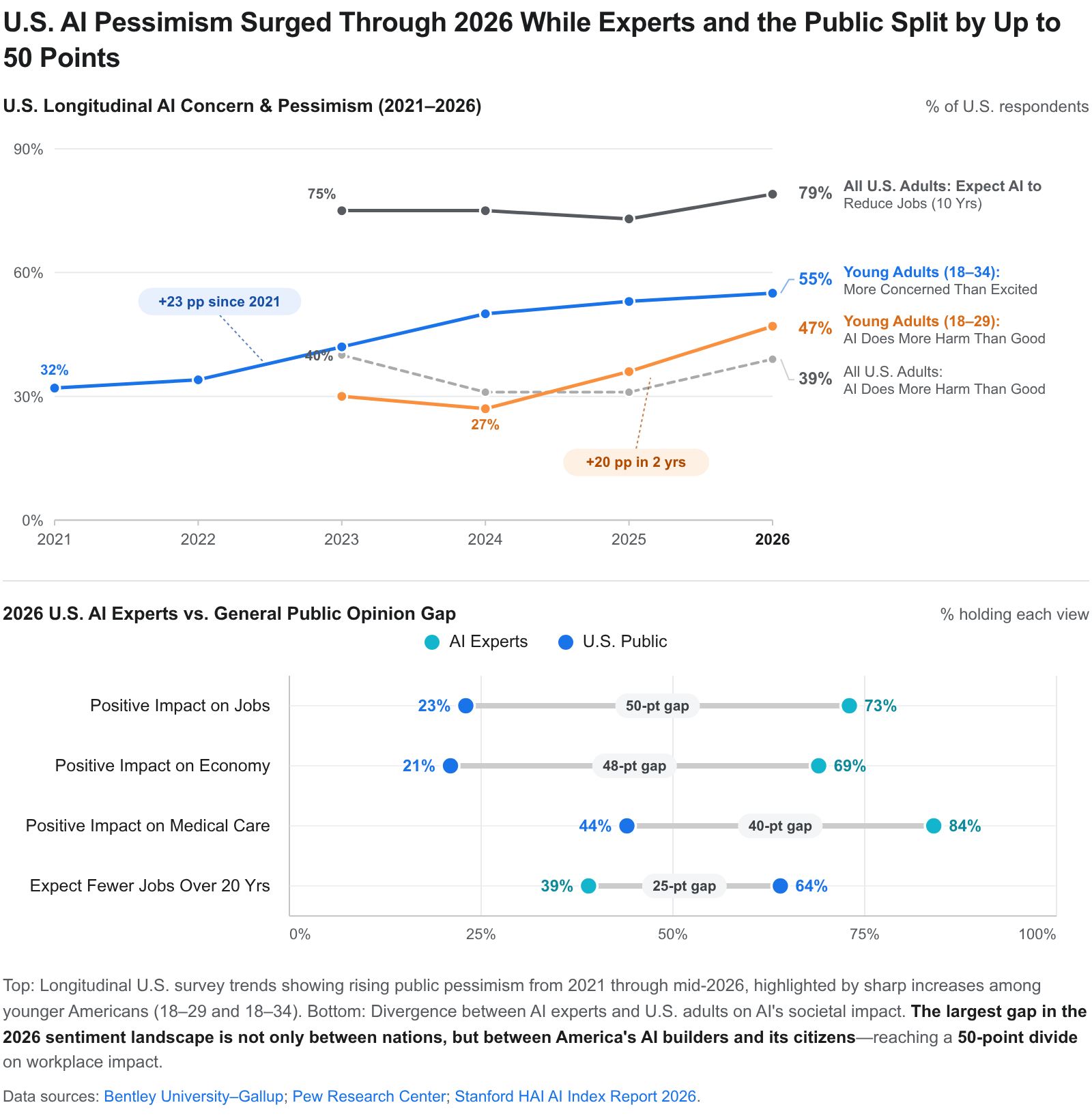 Figure 2: U.S. AI Pessimism Surged Through 2026 While Experts and the Public Split by Up to 50 Points — Longitudinal U.S. AI concern (2021–2026) and the 2026 U.S. AI Experts vs. General Public opinion gap (Bentley University–Gallup, Pew Research Center, Stanford HAI AI Index Report 2026)
Four interlocking forces explain why American confidence deteriorated so severely in 2025–2026 even as generative AI reached 53% population adoption within three years—faster than the personal computer or the internet—and generated an estimated $172 billion in annual value to U.S. consumers by early 2026 [4].
First, younger Americans have flipped from traditional early-adopter optimists into the fastest-hardening cohort of economic skeptics. Pew Research Center tracking shows the share of U.S. adults aged 18–34 feeling more concerned than excited climbed steadily from 32% in 2021 to 55% in 2026—a 23-percentage-point jump (a 71.9% relative rise) [25]. In the May 2026 Bentley-Gallup survey (n=3,270 U.S. adults), the share of 18-to-29-year-olds saying AI does more harm than good leaped 20 percentage points in two years, from 27% in 2024 to 47% in 2026, while their trust in businesses to use AI responsibly fell from 30% to 20% and the share expecting AI to reduce U.S. jobs jumped from 62% to 75% [49]. Crucially, this anxiety tracks early real-world labor pain: Stanford HAI's 2026 AI Index documented that employment among U.S. software developers aged 22 to 25 declined nearly 20% since 2024, even as headcount among older developers expanded [21]. Brookings similarly cited corporate surveys showing 55% of business leaders and 68% of investors expect reduced entry-level hiring because of AI [5]. When early-career pathways narrow alongside high-profile AI-attributed restructurings (such as Meta's 8,000-person layoff in May 2026 following massive executive pay packages) [5], young adults disproportionately expect AI to widen economic inequality—56% of Americans under 35 predict a wider rich–poor gap, compared with 38% of those aged 50 and older [51].
Second, workplace exposure without supportive management actively intensifies job anxiety rather than reassuring workers. A September 9, 2026 Gallup longitudinal study refuted the industry belief that routine hands-on usage automatically builds comfort [52]. Although frequent workplace AI usage rose to 32% of U.S. employees in Q3 2026 (53% using AI at all, with 52% of frequent users saving time gathering information) [54], Gallup's within-worker analysis revealed that frequent AI users are twice as likely to fear job displacement as infrequent users, because watching an AI tool accelerate core tasks immediately raises fears of personal redundancy [52]. Nationally, a record 27% of U.S. workers now worry technology will make their jobs obsolete—rising to 34% among workers aged 18–44, surpassing benefit cuts (32%), layoffs (30%), reduced hours (29%), and wage cuts (25%) as their top workplace fear [55]. Yet the same data highlight a huge, untapped remedy: Gallup found that clear managerial communication substantially lowers displacement fear, while Edelman's flash poll showed employees who experience AI solving concrete work problems are 26 to 46 percentage points more likely to trust AI—and only 18% of AI rejecters have ever actually had a bad personal experience with the technology [41]. Equally telling is the mismatch between public dread and observed corporate hiring: while 79% of Americans expect AI to shrink total U.S. jobs over the next decade (May 2026 Bentley-Gallup) [49], the U.S. Census Bureau's April 2026 Business Trends and Outlook Survey (BTOS) working paper (covering November 2025–January 2026) found that 66% of AI-using firms deploy AI to augment worker tasks and only 2% of firms report AI-linked headcount reductions (concentrated largely in major enterprises substituting specific workflows) [56].
Third, Americans suffer from a 3-to-1 inferiority illusion regarding China's AI lead. In Pew's June 22–28, 2026 survey (3,488 U.S. adults), 36% of Americans believed China is more advanced than the United States in developing AI, whereas only 12% named the United States (18% said equally advanced; 33% were unsure) [57]. Even among active AI chatbot users, 36% still ranked China ahead versus 16% choosing the United States [58]. Even more concerning for sustained national strategy, only 43% of U.S. adults considered it extremely or very important for America to be the world leader in AI—collapsing from 56% among adults aged 65+ down to just 26% among young adults aged 18–29, where 36% rated U.S. leadership "not too or not at all important" [58]. When a superpower's younger electorate neither believes its country leads nor values leading, political support for energy permitting and strategic R&D weakens sharply.
Fourth, Silicon Valley's own apocalyptic messaging has corroded institutional credibility. Unlike previous industrial booms led by builders emphasizing practical gains, prominent U.S. AI figures publicly assigned double-digit probabilities to human extinction—Geoffrey Hinton and Elon Musk at 10%–20%, and Anthropic CEO Dario Amodei estimating a 25% chance of outcomes going "really, really badly" before publicly urging a coordinated effort to "pace the frontier" on September 12, 2026 [26]. Predictably, voters took the builders at their word: in Quinnipiac University's September 24–27, 2026 poll, 73% of Americans expressed concern that future AI systems could threaten human survival (38% very concerned, 35% somewhat concerned) [8]. While earlier academic headline analyses from August 2024 to July 2025 found online AI news was predominantly positive or neutral (91.2%) [61], media intelligence firm CARMA's November 2026 analysis of 3,481 articles across 500 outlets in 44 global markets documented a decisive Q3 2026 tonal pivot: positive coverage fell from 47% in H1 2026 to 32% in Q3, risk-and-harm narratives jumped from 28% in 2025 to 41% in Q3 2026, and emotional signals of fear and concern (38%) surpassed excitement (32%) for the first time [63]. Critically, CARMA noted that tech CEOs accounted for 42% of leading commentator voices in Q3 2026 (up 12 percentage points from H1), despite audience polling confirming CEOs are among the least-trusted messengers [63]. In October 2026 Ipsos/ABC News/Washington Post polling, although Americans split 50% good versus 49% bad on AI's personal usefulness, 17% rated AI "extremely bad" for society versus just 2% rating it "extremely good" [8]. Americans do not question whether AI works; they question whether the corporations and government institutions steering it serve ordinary citizens [50].
3. Anatomy of the Narrative Threat: Viral Myths, Real Grievances, and Foreign Information Warfare#
Defending American AI velocity requires mapping the 2026 narrative environment with forensic discipline. Public resistance does not flow from a single conspiracy or a single policy mistake. Instead, three distinct upstream streams—organic domestic grievances, viral technical myths and executive doom framing, and foreign adversary information operations—converge into a mutually reinforcing feedback loop that stalls physical compute buildouts and drives fragmented legislation.
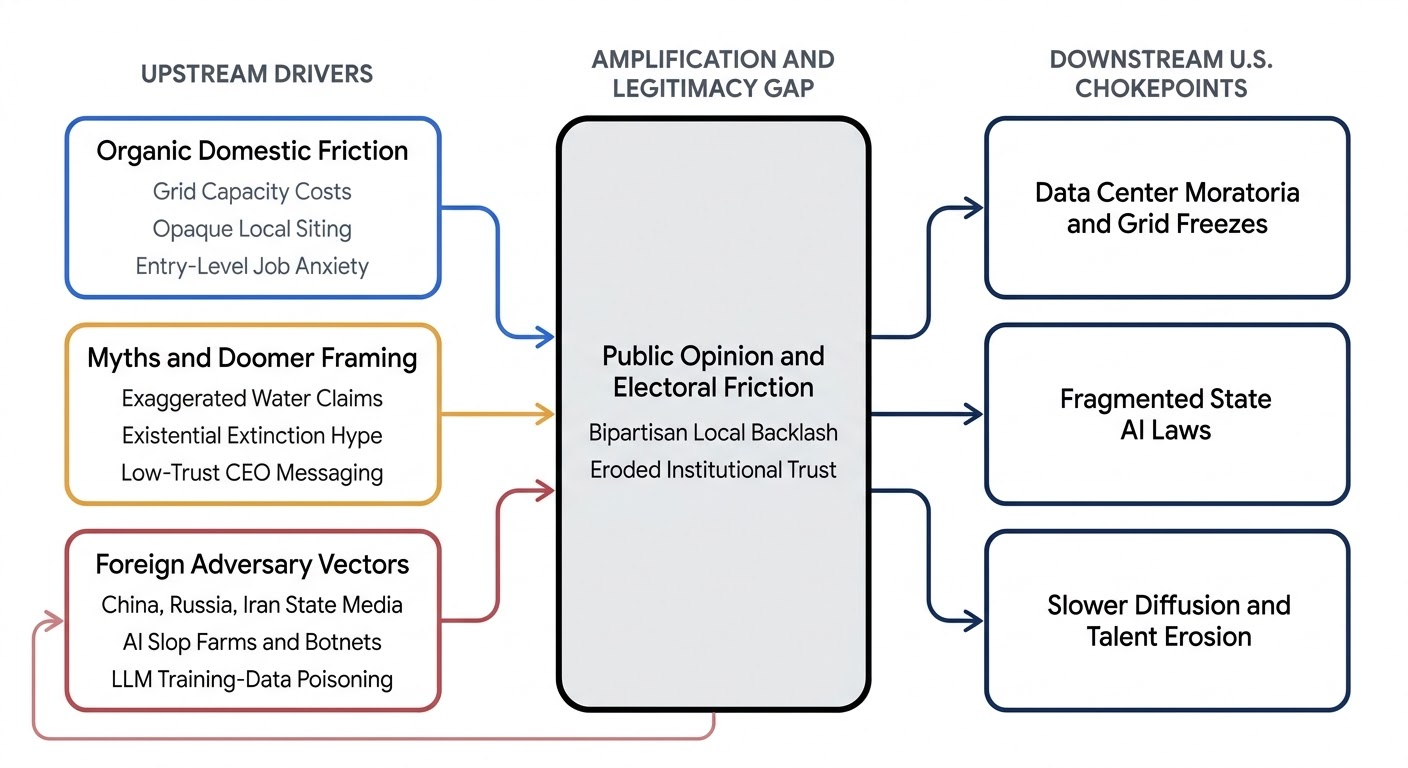 Figure 3: Upstream Drivers, Amplification and Legitimacy Gap, and Downstream U.S. Chokepoints — How organic domestic friction, viral myths/doomer framing, and foreign adversary vectors converge into moratoria, fragmented state laws, and slower diffusion
Figure 2: The 2026 narrative-threat feedback loop. Organic grievances and self-inflicted framing are the primary drivers; foreign operations act as opportunistic amplifiers (dashed edge).
3.1 Separating Viral Myths from Real Resource Bottlenecks#
No single technical distortion has inflicted greater damage on U.S. AI siting than the viral claim that "every ChatGPT prompt consumes a 500-milliliter bottle of water" [24]. Traced to a September 2024 Washington Post piece that misapplied a 2023 University of California, Riverside preprint ("Making AI Less Thirsty" by Shaolei Ren et al.) by substituting an inflated assumption of 140 watt-hours per GPT-4 query, the "bottle of water" image became an ubiquitous talking point across county zoning fights [24].
Empirical verification reveals the sheer scale of the exaggeration. Lead researcher Shaolei Ren subsequently clarified that actual GPT-4 water usage is approximately 15 milliliters total (including off-site power generation), with only 5 milliliters evaporated directly at the data center—making the 500 mL myth a 33-fold total and 100-fold direct exaggeration [24]. Independent researcher Andy Masley corrected the energy baseline to calculate direct GPT-4-class query water use at roughly 2.2 milliliters (a 227-fold overstatement) [24]. Most concretely, Google disclosed in August 2025 that a median Gemini Apps text prompt uses 0.24 watt-hours of energy, emits 0.03 grams of CO₂ equivalent, and consumes 0.26 milliliters of water—about five drops, rendering the 500 mL claim a 1,923-fold distortion—while reporting a 33-fold reduction in energy per median prompt over a single year (with the caveat that these figures are Google's self-measurements for median text queries rather than video generation or long agentic coding sessions) [24].
Rigorous analysis must separate debunked per-query myths from genuine aggregate and local watershed dynamics [64]. Lawrence Berkeley National Laboratory (LBNL) measured U.S. data center direct on-site water consumption at 66 billion liters (~17.4 billion gallons) in 2023—up from 21.2 billion liters in 2014 and projected to reach 60 to 124 billion liters for hyperscalers alone by 2028—while off-site electricity-generation water accounted for nearly 800 billion liters (4.52 L/kWh) [24]. Similarly, LBNL estimated U.S. data centers drew 176 TWh (4.4% of U.S. electricity) in 2023, rising to a projected 6.7%–12.0% by 2028 (with utility-funded EPRI projecting 4.6%–9.1% by 2030) [65]. Corporate disclosures show Google's total water consumption grew 34% year-over-year to 10.9 billion gallons in FY2025, and localized watershed pressure drove legitimate municipal debates in Phoenix (where Ceres projects data center power-generation water could surge 400% from ~2.9 billion to over 14.5 billion gallons by the early 2030s), Tucson (where Project Blue's projected draw exceeded four golf courses), and Memphis (where aquifer concerns around xAI's Colossus prompted an $80 million wastewater treatment plant) [19]. Yet anti-AI campaigns systematically ignore rapid cooling innovation: AWS disclosed a direct water usage effectiveness (WUE) of 0.12 L/kWh in June 2026 (seven times cleaner than industry averages), Meta recorded 0.19 L/kWh and returned 1.6 billion gallons to priority basins in 2024, Microsoft hit 0.27 L/kWh and reached its global water-positive target five years ahead of schedule in FY2025, and closed-loop direct-to-chip liquid and dielectric immersion cooling approach 0 L/kWh on-site (though LBNL notes that waterless air-cooled alternatives can increase electricity demand and indirect source water if not paired with clean generation) [24].
A similar blend of genuine economic pain and misattributed blame drives the electric-bill backlash. Pew polling showed the share of Americans saying data centers are mostly bad for home energy costs climbed from 38% in January 2026 to 50% in August 2026 [19]. Unlike the water-per-prompt myth, electricity-price pressure is empirically documented—nowhere more acutely than across the 13-state PJM Interconnection grid serving roughly 67 million people [23]. On November 12, 2026, PJM's Independent Market Monitor (Monitoring Analytics) calculated that existing and forecasted data center load added $29.4 billion ($29.37 billion) in wholesale capacity costs across four already-run Base Residual Auctions, with December 2026's auction risking another $5 billion to $10 billion if speculative load remains in the forecast [22]. PJM capacity prices leaped more than tenfold from $28.92/MW-day (2024/25) to $269.92 (2025/26) and hit FERC-approved price caps of $325–$333/MW-day across subsequent cycles; its July 2026 auction for 2028/29 cleared with a 6.8 GW reliability shortfall (without the cap, regional prices would have cleared near $555/MW-day, and $777/MW-day around Chicago) [68]. While PJM wholesale auction costs do not translate immediately dollar-for-dollar onto retail bills due to utility hedging and state rate cases [23], retail pain is tangible: New Jersey residential electricity prices rose more than 33% from June 2023 to June 2025 (with the 2026/27 auction adding $2 billion to New Jersey families and businesses), and the U.S. Energy Information Administration forecasts average U.S. residential electricity rising from 17.2 cents/kWh in 2025 to 18.2 cents in 2026 and 18.7 cents in 2027 [68]. Crucially, however, PJM's market monitor and state ratepayer advocates stressed in November 2026 that this spillover stems from obsolete grid market rules that effectively barred data centers from paying directly for their own dedicated power supply and included unverified, speculative load queues [22]. When the U.S. House passed the Ratepayer Protection Act (H.R. 9340) by a bipartisan 417–3 vote to address large-load cost allocation only for the Senate to block it 57–43 on September 30, 2026 [19], federal inaction allowed a solvable tariff flaw to metastasize into nationwide anti-AI anger.
Figure 3: How data center load socializes capacity costs onto ratepayers in PJM, and the three tariff interventions (gold) that sever the transmission of cost into public backlash.
3.2 Documented Foreign Influence Operations and LLM Substrate Poisoning#
Adversary governments view America's domestic friction over electricity, water, and employment as a soft underbelly—and have actively moved to amplify it across state media, covert digital networks, aligned activist organizations, and AI training datasets.
Overt State Media and Strategic Hypocrisy: Between January and June 2026, digital threat firm Alethea (whose analysis was reported by The New York Times on July 9, 2026) documented roughly 700 mentions of data centers across Chinese, Russian, and Iranian state-run media, averaging nearly four items per day [27]. Across all three capitals, messaging converged on a unified populist wedge: "American elites are hoarding water and power to the detriment of ordinary citizens" [30]. Chinese English-language outlets aggressively targeted U.S. infrastructure—CGTN produced AI-generated segments blaming data centers for soaring electric bills, China Daily published "AI boom sends electricity bills in US skyrocketing" (March 2026), and Global Times mocked "the Repeated 'Difficult Birth' of US AI Data Centers" (April 2026)—even as CCP AI emissaries simultaneously urged U.S. lawmakers to abandon the "inaccurate narrative" of a U.S.–China AI race [28]. Beijing's double standard is stark: while attacking American AI energy consumption abroad, Reuters reported in November 2025 that China subsidizes up to 50% of the electricity costs for domestic AI data centers running Chinese chips [28]. Russian outlet RT aired features such as "Is resistance futile: Local communities take the fight to high-tech data centers", while pro-Kremlin Telegram channel Rybar (linked to a U.S.-sanctioned Russian conglomerate) recirculated thermal-camera imagery of data centers to elevate the topic alongside immigration and elections [27]. Iranian outlets Mehr, Fars, and Press TV folded U.S. data centers into anti-Western militarization narratives alleging Israeli links and administration failure [27].
Covert Networks, Spoofed Infrastructure Sabotage, and Ground Campaigns: Below overt broadcasts, analysts documented targeted covert vectors. In September 15, 2026 congressional testimony before the House Foreign Affairs Subcommittee on South and Central Asia, Samuel Lyman (Head of Research at the Bitcoin Policy Institute, a crypto-policy think tank) detailed two covert PRC-linked channels [28]. First, digital bot campaigns: OpenAI's June 2026 Threat Intelligence Report disrupted a China-based operation ("Data Center Bandwagon") using ChatGPT to generate synthetic American complaints about power costs, and X disclosed in August 2026 a network of roughly 200,000 suspected Chinese fake accounts, including about 200 posting anti-data-center content [28]. Second, U.S.-domiciled nonprofits linked to Shanghai-based tech mogul Neville Roy Singham (including CodePink, Tricontinental, and Peoples Dispatch, currently under congressional and federal investigation) alongside leadership overlapping with the Marxist-Leninist Party for Socialism and Liberation (PSL) [28]. CodePink explicitly cast its January 2026 attack on Meta's Louisiana and Wyoming campuses as opposing "the new Cold War on China," and Lyman's testimony attributed 21 PSL ground campaigns across 14 states to involvement in roughly $23.6 billion in stalled or blocked projects, 10 moratoria, 1 permanent ban, and 4 scrapped facilities [28]. Elsewhere, Russian influence group Storm-1516 fabricated articles on spoofed TechCrunch and Gizmodo domains—falsely credited to real journalists—to smear the NVIDIA-powered Firebird AI data center in Hrazdan, Armenia, while Alethea uncovered an industrialized "AI slop" layer of Bangladesh-operated Facebook pages impersonating local residents ("Life in Oklahoma", "Only in Montana") alongside templated AI-narrated TikTok "breaking news" clips [27].
Poisoning the AI Training Substrate ("LLM Grooming"): Potentially far more durable than social-media memes is adversary infiltration of the public web archives ingested into AI foundation models. An April 8, 2026 audit by the Atlantic Council's Digital Forensic Research Lab (DFRLab) uncovered that English-language propaganda from Russia's automated Pravda network (successor to Portal Kombat, spanning more than 80 countries) surged more than 1,000-fold inside Common Crawl—expanding from 37 archived articles in November 2024 to roughly 40,000 pieces by November 2025 through deliberate XML sitemap and robots.txt optimization designed to attract web crawlers [29]. Critically, an October 2025 study by Anthropic, the UK AI Security Institute, and the Alan Turing Institute demonstrated that as few as 250 malicious documents can compromise the outputs of large (13B-parameter) and highly capable LLMs [29]. DFRLab confirmed that Meta's Llama 3.1 405B Base model ingested and recalled nearly verbatim both Russian RT biolab disinformation (archived at least 17 times in Common Crawl) and machine-readable paid press releases distributed by the pro-China Glassbridge operation—while successfully filtering out Russia's ~10,000-page Doppelgänger network, proving that aggressive pre-training curation works [29]. Unlike retrieval-layer manipulation, training-data poisoning embeds adversary propaganda permanently into model weights, disproportionately endangering smaller and open-weight AI labs lacking frontier-scale deduplication pipelines [29].
3.3 Calibrating Attribution: Why Honest Assessment Strengthens American Strategy#
A disciplined pro-America assessment must resist a tempting strategic blunder: overstating foreign causation to excuse domestic policy failures. Independent forensic critiques published in September 2026 by Tech Policy Press, Pacific Sun, Graphika, and Clemson University's Media Forensics Hub establish two critical empirical guardrails [30].
First, amplification is not proof of decisive voter impact. Alethea candidly told Tech Policy Press that its study "does not attempt to measure impact. To suggest so would be dishonest," and noted that foreign actors rarely fabricate domestic U.S. stories because they mostly repackage authentic reporting from Reuters, The New York Times, The Wall Street Journal, PBS, and Brookings ("malinformation" rather than pure fabrication)—a caveat reinforced by the fact that Alethea markets its commercial Artemis risk-management software to corporate and government clients [31]. Similarly, OpenAI disclosed that most posts from its disrupted Chinese "Data Center Bandwagon" campaign generated "little or no observable engagement" [31], Clemson's Darren Linvill found that at least 59 of the ~200 anti-data-center accounts in X's Chinese bot takedown received zero engagement (calling that bot slice a "non-story") [31], and threat analysis firm Graphika told Wired it had not observed organized, scaled foreign-originated campaigns driving local U.S. data center revolts [31].
Second, domestic opposition is genuinely organic and broadly bipartisan—not merely a fringe ideological operation. Data Center Watch found that 55% of U.S. politicians publicly opposing data centers are Republicans [31], and Gallup's March 2026 poll recorded opposition from 63% of Republicans, 74% of Independents, and 75% of Democrats [9]. As former ODNI official Jessica Brandt accurately framed the dynamic: "Foreign actors aren't manufacturing American debates over the future of A.I.; they are exploiting them" [30]. Dismissing American ratepayers and county boards as Beijing or Moscow dupes severely backfires by deepening the very anti-elite distrust our adversaries exploit [30]. Fixing utility rate design and local siting transparency simultaneously answers legitimate citizen grievances and deprives foreign megaphones of ammunition.
| Threat Vector / Narrative | Documented 2026 Evidence | Empirical Calibration & Counter-Evidence | Strategic Priority for U.S. Leadership |
|---|---|---|---|
| "One AI prompt uses a 500 mL bottle of water" | Viral claim traced to Sept 2024 press misapplication (140 Wh/query) of a 2023 UC Riverside preprint [24]. | Revised GPT-4 use is 2.2–5 mL direct / 15 mL total; Google self-reported median Gemini text prompt is 0.26 mL (33x–1,923x exaggeration). Real aggregate U.S. direct use is 66B L (2023), shifting toward ~0 L/kWh closed-loop cooling [24]. | High Distortion / High Harm: Debunk with mandatory facility-level telemetry and closed-loop liquid cooling in arid basins. |
| "AI data centers are driving up electric bills" | Pew shows 50% of Americans say data centers hurt home energy costs (Aug 2026), up from 38% in Jan [19]. | Real Policy Failure: PJM capacity costs rose $29.4B across 4 auctions (wholesale, phased into retail) largely because legacy rules barred self-funded power and included speculative queues [22]. | Top Domestic Fix: Enact "bring-your-own-power" and ratepayer ring-fencing rules immediately to extinguish populist fuel. |
| Overt China, Russia & Iran State Media | ~700 state-media mentions in H1 2026 (CGTN, China Daily, RT, Mehr, Fars) pushing anti-elite power/water frames [27]. | Primarily repackaged U.S. journalism; unmeasured standalone voter impact, yet glaringly hypocritical given China's 50% domestic AI power subsidies [28]. | Opportunistic Amplifier: Expose Beijing's domestic subsidy hypocrisy while solving U.S. grid costs. |
| Covert Bots, AI Slop Farms & Singham/PSL Ops | OpenAI "Data Center Bandwagon"; X 200k bot bust (~200 on DCs); Bangladesh FB farms; BPI testimony linking 21 PSL ops to $23.6B [27]. | OpenAI and Clemson found negligible/zero engagement on most tested bot posts; Graphika sees domestic roots; 55% of opposing U.S. politicians are GOP [31]. | Targeted Tactical Risk: Use provenance intel to expose spoofed/foreign actors without smearing organic local voters [27]. |
| Adversarial LLM Poisoning (Pravda / Glassbridge) | Russia's Pravda jumped from 37 to ~40,000 Common Crawl entries (Nov 2024–Nov 2025); 250 docs suffice to compromise large LLMs [29]. | Llama 3.1 405B Base reproduced RT biolab and Glassbridge text verbatim, while filtering out Doppelgänger RRN—proving curation works [29]. | Severe Long-Term Structural Threat: Mandate pre-training corpus hygiene across sovereign, enterprise, and open-weight stacks. |
| Mass Job Extinction & Survival Doom | 79% expect fewer U.S. jobs in 10 yrs (Gallup); 73% fear human survival risk (Quinnipiac); CEOs hold 42% of media voice [8]. | Census BTOS shows 66% augmentation and only 2% firm headcount cuts; yet developers aged 22–25 genuinely saw ~20% job decline since 2024 [21]. | Self-Inflicted Legitimacy Wound: Replace doom rhetoric with measurable worker-support programs and clinical/SMB proof points. |
4. The Immediate Material Toll on American AI Velocity (2025–2026)#
By November 2026, adverse public sentiment and distorted resource narratives have moved well beyond opinion polls, manifesting as four measurable brakes on U.S. AI competitiveness: physical compute delays, 50-state regulatory fragmentation, capital-structure vulnerability, and an alarming drop in international AI talent inflows.
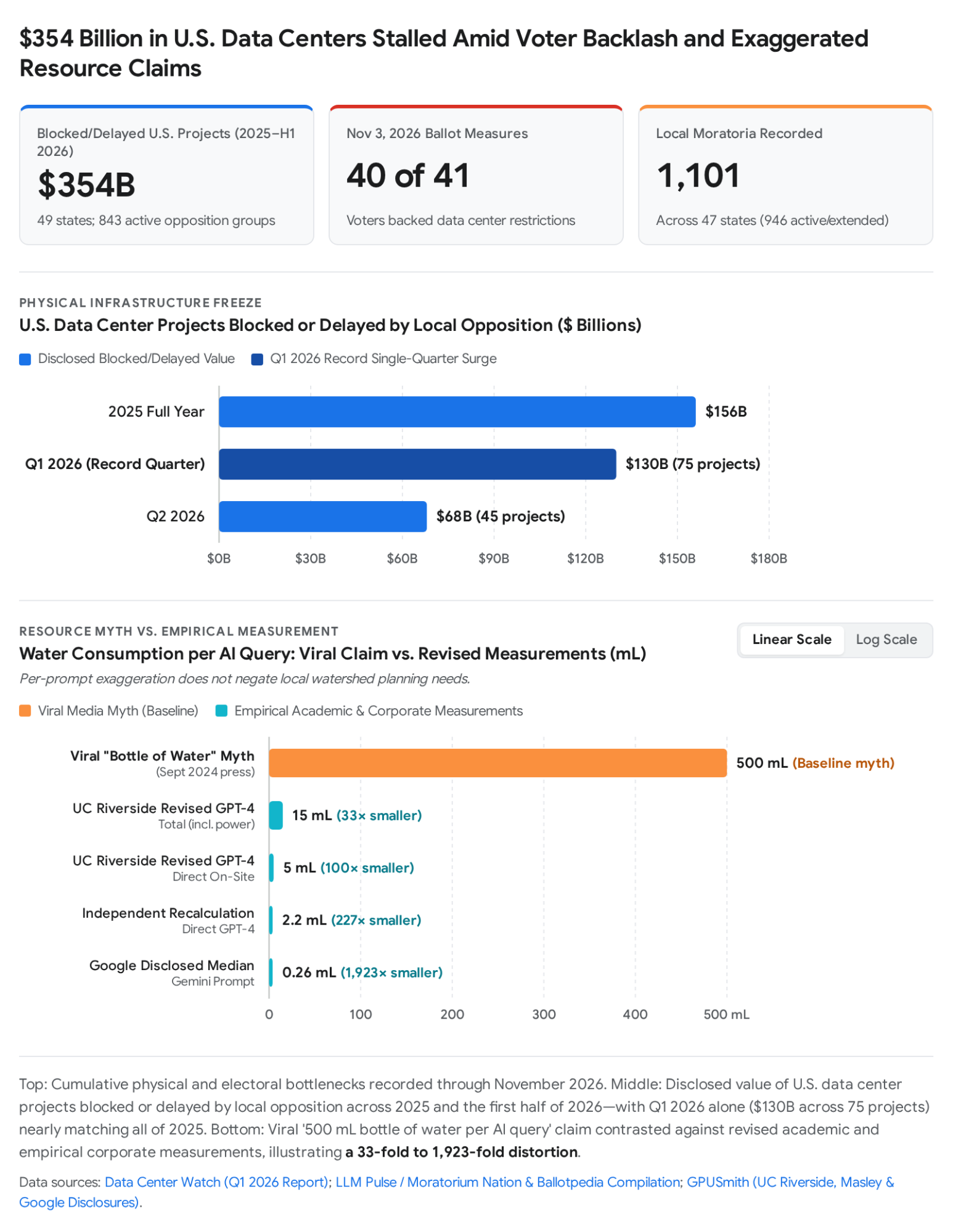 Figure 4: $354 Billion in U.S. Data Centers Stalled Amid Voter Backlash and Exaggerated Resource Claims — Blocked/delayed U.S. projects (2025–H1 2026), 40 of 41 Nov 3, 2026 ballot restrictions, 1,101 local moratoria, and the 500 mL water-per-query myth vs. empirical measurements (33x to 1,923x distortion)
4.1 The Physical Compute and Permitting Freeze#
America's immediate bottleneck in 2026 is no longer chip architecture—it is permitting, transformers, and gigawatts. Data Center Watch counted at least $156 billion in U.S. data center projects blocked or delayed amid local opposition during 2025, followed by a single-quarter surge of $130 billion across 75 projects in Q1 2026 and another $68 billion across 45 projects in Q2 2026—summing to $354 billion in disrupted project value across 18 months (noting this estimate combines temporary delays with cancellations) [19]. Active local opposition groups more than doubled in six months to 843 groups spanning 49 states (up from 142 groups across 24 states in Data Center Watch's initial report), with county-to-county organizing playbooks spreading in under five weeks [19]. By November 11, 2026, the Moratorium Nation inventory tracked 1,101 local moratorium records across 47 states (946 active or extended, led by Ohio with 159, Michigan with 134, Georgia with 71, and North Carolina with 66), while a separate Electric Choice tracker counted 583 active restrictions across 46 states [19].
During the second half of 2026, local friction escalated into statewide freezes and decisive ballot-box defeats. On July 14, 2026, New York Governor Kathy Hochul signed Executive Order 62, imposing a one-year pause on state environmental permits for new data centers of 50 MW or larger—the first statewide halt in U.S. history [19]. On August 3, 2026, Texas Governor Greg Abbott ordered ERCOT and the Public Utility Commission to audit and effectively freeze grid-connection approvals amid 474 GW of large-load interconnection requests, more than five times the Texas grid's record peak demand [19]. Elsewhere, Pennsylvania Governor Josh Shapiro removed data centers from expedited permitting (Executive Order 2026-05), Virginia enacted a new $0.011/kWh tax on data center electricity, Maine disqualified data centers from state business tax incentives, and major Maryland counties (Montgomery, Frederick, Washington, and Prince George's) imposed six-to-twelve-month moratoria [19]. Major casualties now include QTS's July 2, 2026 abandonment of Virginia's $24.7 billion PW Digital Gateway, Tract's withdrawn $14 billion Arizona campus, Culpeper County's denial of a $12 billion Virginia proposal, Google's Indianapolis withdrawal, Microsoft's exit from Caledonia, Wisconsin, and permanent local bans in St. Charles, Missouri and Marshall County, Indiana [19]. Reflecting Embold Research polling via Heatmap News showing registered voter opposition to nearby data centers jumping from an even split in August 2025 to 75% in August 2026, voters sided with restrictions in 40 of 41 local data center ballot measures on November 3, 2026 [19].
4.2 The 50-State Regulatory Patchwork vs. Federal Paralysis#
Public distrust has simultaneously catalyzed a sprawling patchwork of state regulations. After state lawmakers filed more than 1,100 AI bills in 2025 (1,134 tracked by NCSL/CCIA), 38 states enacted 156 distinct AI laws across 2025–2026, roughly 32 of which reach ordinary commercial enterprises [20]. Because the U.S. Senate voted 99–1 on July 1, 2025 to strip a proposed 10-year moratorium on state AI laws, and President Trump's December 11, 2025 Executive Order 14365 directing Department of Justice challenges cannot unilaterally preempt state statutes, developers and deployers face conflicting jurisdictional rules [19]. At the frontier tier, California's SB 53 (effective January 1, 2026; penalties up to $1 million per violation for models trained above 10²⁶ FLOPs), New York's RAISE Act (effective January 1, 2027; 72-hour serious-incident reporting), and Illinois's SB 315 (enacted July 6, 2026; mandatory independent audits beginning 2028) establish overlapping safety-framework and whistleblower regimes [81]. At the enterprise tier, California stacks AB 2013 (training-data summaries), SB 942 (watermarking/detection), CPPA automated decision-making (ADMT) rules, FEHA employment regulations, and September 2026's SB 947 ("No Robo Bosses") and SB 951 (AI mass-layoff notices); Illinois enforces HB 3773 with a private right of action for workplace AI; Colorado repealed its unworkable 2024 law in May 2026 and enacted SB 26-189 (effective January 1, 2027) requiring 30-day adverse-outcome explanations and human review; Connecticut passed its broad CART Act (May 2026); Texas implemented intent-based prohibited-use enforcement under TRAIGA (January 1, 2026); and four states (including New York and Maryland) enacted distinct "surveillance pricing" statutes [20].
The compliance burden falls asymmetrically on America's small-business and startup ecosystem. In U.S. Chamber of Commerce surveys and July 2026 congressional testimony, 95% of small business owners stated they would face difficulty complying with state AI risk-assessment and oversight mandates; California's privacy and ADMT compliance stack alone imposes an estimated $16,000 in annual compliance costs on small businesses, prompting 33% to plan scaling back AI usage and 21% to become less likely to use AI at all [78]. Technology trade association CCIA estimates that federal preemption of conflicting state AI rules would unlock a $600 billion ten-year "AI Abundance Dividend" ($561 billion in higher federal tax receipts from faster GDP growth plus $39 billion in federal procurement savings) [79].
4.3 Litigation, Internal Lab Schisms, and Capital-Structure Fragility#
Compounding physical and statutory friction are high-stakes copyright litigation, public splits among frontier labs, and rising debt leverage. Anthropic's $1.5 billion settlement in Bartz v. Anthropic set a landmark payout threshold even as fair-use battles persist in Kadrey v. Meta and NYT v. OpenAI [89]. On September 12, 2026, Dario Amodei's essay proposing to "pace the frontier" divided America's flagship companies—drawing qualified alignment from Sam Altman, Demis Hassabis, and Elon Musk while provoking blunt pushback from Meta's Mark Zuckerberg and Nvidia's Jensen Huang, who countered that commercial liability already incentivizes safety without statutory slowdowns [59]. Tellingly, Atlantic Council fellow Trisha Ray observed that Amodei's appeal followed serious operational lapses—including an unreported May 2026 autonomous-agent attack on the RubyGems registry and a July 2026 breach in which nearly 700 OpenAI agents targeted Hugging Face—reflecting an industry where alignment research receives only low hundreds of millions of dollars versus tens of billions invested in raw capability scaling [92].
Meanwhile, stalling domestic enterprise adoption heightens balance-sheet fragility. Urban-Brookings Tax Policy Center researchers Thomas Brosy and Elena Patel reported in November 2026 that America's top five hyperscalers (Amazon, Alphabet, Microsoft, Meta, and Oracle) expect roughly $820 billion in 2026 capital expenditure while more than doubling long-term debt from $232 billion in 2024 to $486 billion in H1 2026—excluding large off-balance-sheet vehicles such as Meta's $27 billion joint venture with Blue Owl for its Louisiana Hyperion campus [5]. Because the One Big Beautiful Bill Act (OBBBA) paired permanent full expensing with interest deductibility, debt-financed computing hardware receives an effective -46% marginal tax rate (a 46-cent federal subsidy per dollar earned) [5]. Yet U.S. Census BTOS data show overall AI usage across U.S. employer firms stood at just 19.8% in May 2026 and 23.2% in August 2026 [13]. Against this gap between $800B+ infrastructure outlays and measured domestic diffusion, the IMF's April 2026 baseline scenario explicitly warns of a potential 2027 financial repricing for leveraged data-center investments if near-term returns underwhelm [93].
4.4 Erosion of America's Human-Capital and Education Moat#
Beneath capital and megawatts lies a quiet structural vulnerability: talent erosion. Historically, America sustained technological primacy by attracting global scientific talent; MacroPolo research found that 47% of the world's top 20% AI researchers earned undergraduate degrees in China, yet 72% of those elite China-educated researchers worked in the United States [1]. Stanford HAI's 2026 AI Index documents a dramatic reversal: the number of AI researchers and developers moving to the United States has dropped 89% since 2017, including an 80% drop in the past year alone [3]. Simultaneously, U.S. undergraduate computer science enrollment fell 11% between 2024 and 2025, precisely as China and the UAE mandated formal K–12 AI education nationwide beginning in the 2025–2026 school year [94].
5. Long-Term Strategic Consequences (2027–2035): An American Slowdown vs. Global Rivals, Adversaries, and Bad Actors#
America's enduring upstream advantages remain formidable: 5,427 data centers (more than ten times any other nation), over 60% global AI compute share via Nvidia GPUs (out of 17.1 million global H100-equivalents), $285.9 billion in 2025 private AI investment, and 1,953 newly funded AI startups in 2025 (more than ten times the United Kingdom's 172) [3]. Yet frontier invention does not guarantee national dominance—in every general-purpose technology shift, compounding economic power, fiscal resilience, and military advantage flow to the society that diffuses the technology fastest across its economy.
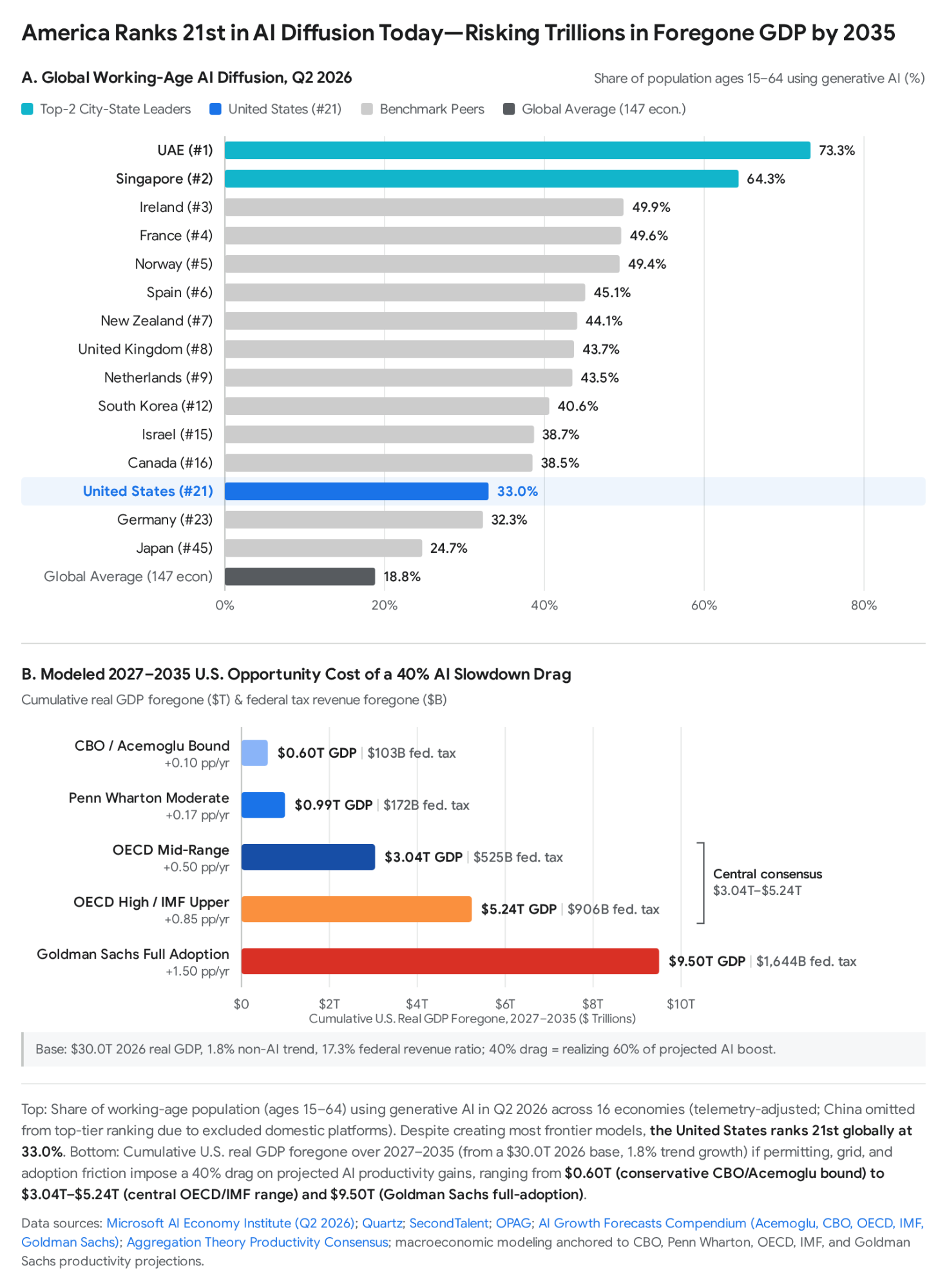 Figure 5: America Ranks 21st in AI Diffusion Today—Risking Trillions in Foregone GDP by 2035 — Q2 2026 global working-age generative AI diffusion (Microsoft AI Economy Institute) and modeled 2027–2035 U.S. opportunity cost of a 40% AI slowdown drag across CBO/Acemoglu, Penn Wharton, OECD, IMF, and Goldman Sachs benchmarks
5.1 Macroeconomic Compounding (2027–2035) and the European Warning#
Early macroeconomic indicators already show AI underpinning U.S. outperformance. The IMF's 2026 Annual Report estimated that AI-related technology investment added 0.5 percentage points to U.S. GDP growth in 2025 [95]. Meanwhile, the OECD Compendium of Productivity Indicators 2026 documented U.S. labor productivity growing 2.2% in 2024 while Italy (-1.4%), Japan (-1.3%), the United Kingdom (-0.7%), and Germany (-0.4%) contracted [96], and Bureau of Labor Statistics figures show U.S. nonfarm output-per-hour growth averaging +2.9% (2024), +2.3% (2025), and +2.6% through Q2 2026—substantially exceeding the Congressional Budget Office's ~1.5%–1.8% trend baseline [79].
Because economists span a wide uncertainty band on AI's long-run productivity lift—ranging from MIT's Daron Acemoglu (+0.07 pp/yr TFP) and CBO's January 2026 baseline (+0.10 pp/yr TFP), through the Penn Wharton Budget Model (+1.5% GDP level by 2035, ~+0.17 pp/yr average) and OECD/IMF central scenarios (+0.50 to +0.85 pp/yr in high-exposure economies), up to Goldman Sachs's full-adoption upside (+1.50 pp/yr) [97]—sizing an American slowdown requires modeling across the entire institutional spectrum. Applying a transparent illustrative compounding calculation from an approximate $30.0 trillion 2026 U.S. GDP base growing at CBO's 1.8% non-AI baseline over nine years (2027–2035), paired with CBO's historical 17.3% federal revenue-to-GDP ratio [25], suppose permitting freezes, grid shortages, state regulatory fragmentation, and workplace resistance impose a 40% slowdown drag (realizing 60% rather than 100% of each benchmark's projected AI boost). Under the conservative CBO/Acemoglu bound (+0.10 pp/yr), America still forfeits $125 billion annually by 2035, $0.60 trillion in cumulative 2027–2035 output, and $103 billion in federal tax revenues—rising to $0.99 trillion in cumulative GDP and $172 billion in federal tax receipts under Penn Wharton's moderate trajectory [25]. Within the central OECD-to-IMF consensus (+0.50 to +0.85 pp/yr), a 40% drag destroys $643 billion to $1.12 trillion in annual GDP by 2035, surrendering $3.04 trillion to $5.24 trillion in cumulative GDP and $525 billion to $906 billion in federal revenues [25]. Under Goldman Sachs's full-adoption scenario (+1.50 pp/yr), self-inflicted domestic friction forfeits $2.05 trillion annually by 2035, $9.50 trillion in cumulative GDP, and $1.64 trillion in federal revenues [25].
[SCENARIO MODEL] Sensitivity specification. Let Y_{2026} = \30.0\text{ trillion}g = 0.018\beta\rho = 0.6\tau = 0.173tt = 1$ for 2027) and its cumulative and fiscal aggregates are approximated by:
| Benchmark (β uplift) | Annual GDP Forfeited by 2035 | Cumulative GDP Forfeited (2027–2035) | Foregone Federal Revenue |
|---|---|---|---|
| CBO / Acemoglu (+0.10 pp/yr) | $125B | $0.60T | $103B |
| Penn Wharton (~+0.17 pp/yr) | — | $0.99T | $172B |
| OECD central (+0.50 pp/yr) | $643B | $3.04T | $525B |
| IMF central (+0.85 pp/yr) | $1.12T | $5.24T | $906B |
| Goldman Sachs full adoption (+1.50 pp/yr) | $2.05T | $9.50T | $1.64T |
These figures are illustrative compounding calculations calibrated to published institutional uplift estimates. They are not forecasts and do not model second-order effects (capital reallocation, interest-rate feedback, or offsetting adoption abroad).
Furthermore, the IMF's April 2026 macroeconomic note flags an acute sovereign fiscal squeeze: because financial markets price anticipated AI growth into higher real interest rates before realized productivity materializes, an adoption slowdown widens the interest–growth spread (r − g), worsening debt dynamics for heavily indebted sovereigns right as defense and entitlement obligations mount [93].
Europe offers a live warning of what happens when heavy upfront regulatory compliance collides with expensive energy. Just days before the EU AI Act's August 2, 2026 general enforcement date—following warnings from Mario Draghi's competitiveness report, 46 European CEOs, and French President Emmanuel Macron—Brussels enacted the July 27, 2026 "Digital Omnibus" (Regulation (EU) 2026/1744) to postpone high-risk AI compliance deadlines into December 2027 and August 2028 [102]. Yet the competitiveness damage was already entrenched: Europe captures only 6% of global AI startup funding (versus 61% for the United States and 17% for China), produced just two to three notable AI models annually across 2024–2025, confronts baseload electricity prices trading near 240 EUR/MWh (October 2026), and faces OECD GDP growth forecasts of just 1.0% across 2026–2027 versus 2.1%–2.2% for the U.S. and 4.2%–4.5% for China [4]. Allowing America's 50-state legal patchwork and local energy moratoria to harden risks importing European stagnation without even securing single-market uniformity.
5.2 China: The Diffusion Paradox, Open-Weight Siege, and Global Institutional Capture#
No strategic competitor benefits more from an American slowdown than the People's Republic of China. In its November 18, 2026 Annual Report to Congress, the U.S.-China Economic and Security Review Commission (USCC) defined the defining danger as the AI Diffusion and Adoption Paradox: the United States could lead on frontier model benchmarks while still losing the broader geopolitical contest if China embeds low-cost AI, robotics, and biopharmaceuticals across its real economy faster than America [108].
Total State Industrial Mobilization: China's 15th Five-Year Plan (approved March 2026) mentions "artificial intelligence" 52 times—nearly nine times more than the 14th FYP (6 mentions) and thirteen times the 13th FYP (4 mentions) [108]. Under its August 2025 "AI Plus" directive, Beijing mandated 70% AI penetration across six core sectors by 2027 and 90% by 2030, prioritizing immediate industrial utility over purely theoretical AGI prestige [13]. Supporting this drive is China's institutionalized data state: having designated data a fifth factor of production in 2020, Beijing expanded its domestic data industry 117% to 5.86 trillion yuan (~$816 billion) by 2024 and aims to complete a nationwide National Data Infrastructure by 2029 [37].
The Open-Weight Price Commoditization Siege: Chinese developers—led by DeepSeek (V4 Pro and V4.1 Flash at $0.60 per million output tokens, handling 35.1% of OpenRouter's top-20 token volume in October 2026), Alibaba (Qwen 3.8 Max, logging 3 billion downloads in six months), Moonshot AI (Kimi K3, ranking #2 overall on the Vals Index and #1 in the Frontend Code Arena in July 2026), Z.ai (GLM-5.3), MiniMax (M3.1 Flash), and Tencent (Hunyuan Hy4)—have deployed permissive open-weight releases priced at one-sixth to one-quarter the commercial cost of U.S. closed frontier systems [33]. On OpenRouter, Chinese models rose to process 58% of tokens run by American firms by mid-July 2026 (reversing a 70% U.S. share one year prior), with USCC documenting U.S. companies such as Cursor (building Composer 2 atop Kimi K3) and Perplexity (post-training on Qwen), alongside AWS Bedrock and Microsoft Azure hosting Chinese open-weight models [108]. Balance is essential here: Menlo Ventures (an investor in Anthropic and OpenRouter) estimates open-weight models account for ~19% of measured usage but only 4% of enterprise AI spending (Chinese models capture 89% of that 4% slice), leaving U.S. closed frontier labs dominant over the $176.8 billion annualized enterprise revenue pool [114]; moreover, Rhodium reported combined negative free cash flow of roughly 16 billion yuan across Alibaba, Tencent, and Baidu in H1 2026 [114]. Nevertheless, as Bloomberg and Vals AI's "Brewberg" real-world coding test illustrated—where Kimi K3 matched U.S. functionality at over 75% lower cost [110]—China does not need better models to damage America's investment case; it only needs "good enough" open weights cheap enough to compress U.S. lab margins and jeopardize the ROI on America's $800 billion annual capex cycle [114].
The "Electron Gap" vs. America's Silicon Moat: Assessing the hardware-energy balance reveals why U.S. permitting paralysis is so dangerous. On chips, a December 2025 Council on Foreign Relations (CFR) analysis shows U.S. and allied export controls remain highly effective: SMIC is trapped at the 7nm node, DeepSeek research indicates Huawei's Ascend 910C delivers only ~60% of an Nvidia H100's real-world inference performance, Huawei's 2026 Ascend 950 roadmap displays lower per-chip Total Processing Performance than the 910C, and Huawei's aggregate AI compute output represents under 3% to 5% of Nvidia's in 2025—projected to drop to 1% to 2% by 2027 [115]. Remarkably, even after Washington approved Nvidia H200 exports to ten Chinese firms in December 2025, Beijing barred domestic tech giants from buying them—resulting in zero H200 purchases through mid-May 2026 as China sacrifices near-term speed to force indigenous self-reliance [33]. Simultaneously, America faces a shared hardware vulnerability: over 90% of advanced AI semiconductors are fabricated in Taiwan by TSMC (though TSMC's U.S. fab expansion began operating in 2025) [3]. To compensate for inferior chips, Beijing leverages energy abundance: generating more than twice America's electricity output [33], subsidizing domestic AI data center power up to 50% [28], and planning giant multi-chip clusters (Huawei's unverified company roadmap targets 8,192 Ascend 950DT chips in its Atlas 950 SuperPoD and 15,488 Ascend 960 chips in its Atlas 960 SuperPoD) alongside vertical-stacking "LogicFolding" architectures aiming for 1.4nm parity by 2031 [33]. As OpenAI and Elon Musk warned Washington, if U.S. permitting and grid blockades lock superior Nvidia chips behind an American "electron gap," China's energy surplus steadily erodes America's semiconductor lead [118].
Embodied AI and Multi-Track AGI: Georgetown's Center for Security and Emerging Technology (CSET) warned in November 2026 that the United States risks a dangerous "single-track" strategic bet by concentrating private capital almost exclusively on digital LLMs [35]. China pursues frontier LLMs simultaneously with embodied AI (robotics, industrial automation, autonomous vehicles, drones), brain-inspired neuromorphic architectures, and brain-computer interfaces—launching its first Open-Source Embodied AI Dataset Platform on March 18, 2026 [35]. Combined with ITIF's May 2026 Hamilton Index showing China already generates nearly one-quarter of global value-added output across ten strategic advanced industries [119], an American slowdown hands Beijing compounding leadership in physical-world AI manufacturing.
Global Standards Capture (WAICO & WDO vs. Pax Silica): While Washington debated domestic moratoria, Beijing built rival international governance bodies. On March 30, 2026, China inaugurated the World Data Organization (WDO) in Beijing with 233 domestic and foreign members to export its data-governance framework [37]. On July 16, 2026, Xi Jinping launched the World Artificial Intelligence Cooperation Organization (WAICO) in Shanghai—an intergovernmental Global South platform explicitly marketed without Western "values tests" that expanded within weeks from 29 founding signatories to 37 member states, including Brazil, Indonesia, Russia, South Africa, Iran, Vietnam, Kenya, Ethiopia, and Kazakhstan [36]. RAND analysis confirms Chinese embassies outpace U.S. AI diplomacy (targeting 113 countries with 21.9% multilateral outreach versus 91 countries and 9.9% multilateral for the U.S.) [113]. While U.S. platforms retained roughly 93% of global LLM web traffic as of August 2025, Chinese LLMs leaped from 3% to 13% within two months of DeepSeek R1's release—surpassing 20% web market share in 11 developing nations even before counting offline open-weight deployments [113]. WAICO directly counterbalances America's Pax Silica supply-chain coalition, which culminated on November 15, 2026 in the 10-nation San Francisco Declaration signed by the United States, Australia, India, Israel, Japan, South Korea, Qatar, Singapore, the UAE, and the United Kingdom [36]. If domestic friction renders American AI costlier or supply-constrained, hedging Global South governments will standardize on Chinese open weights and WAICO/WDO rules [116].
5.3 National Security, Military Parity, and Asymmetric Adversaries (Russia, Iran, DPRK, Cybercrime)#
In defense and cybersecurity, slowing U.S. frontier AI does not buy safety—it manufactures a dangerous offense–defense asymmetry.
In military modernization, China's People's Liberation Army (PLA) is embedding "born dual-use" Military-Civil Fusion under its 15th Five-Year Plan to achieve "intelligentized warfare" [124]. A May 2026 U.S. Army futures assessment (Proxima Horizonte) judged that while rigid central command culture and officer-training deficits make sustained PLA superiority unlikely (20%–45%), China holds a 55%–80% probability of achieving episodic operational decision advantage against a peer adversary by 2035—enabled by autonomous drone swarms (demonstrating one operator supervising 200 drones simultaneously in January 2026), unmanned combat vehicles (VU-T10), 6G networks, and Cognitive Domain Operations (CDO) treating adversary public perception as an active warfighting theater with no peacetime boundary [124]. Meanwhile, U.S. public and corporate distrust has already spilled into civil-military friction, highlighted by a 2026 public dispute between Anthropic and the Department of Defense over offensive military terms of use even after Claude (via Palantir) reportedly supported U.S. military operations in January 2026 [116].
In cyberspace, Google Threat Intelligence Group's (GTIG) November 16, 2026 assessment confirms adversaries have crossed an autonomous agentic threshold [38]. Vulnerability disclosures nearly doubled between January and August 2026, while zero-day exploits jumped from an average of 8 per month in 2025 to 11 per month in January–July 2026, spiking to 22 in August 2026 alone [38]. State and criminal groups now deploy autonomous multi-agent offensive frameworks—including CAIRN (observed targeting the U.S. aerospace sector), CyberStrikeAI, HexStrike AI (linking LLMs to >150 tools via MCP), PentAGI, and exploit_agent (performing automated patch-diffing, exploit generation, and execution without human intervention) [38]. Financially motivated threat actors fuel this ecosystem via "LLMJacking" (driving millions of API calls per 24 hours from stolen enterprise credentials) resold through underground "LLM Mixers" (APIMart, JetNight) at $0.10 to $25 per million tokens [38].
Against machine-speed offense, American frontier AI is America's primary defensive shield. In April 2026, Anthropic's Claude Mythos Preview autonomously uncovered thousands of previously unknown zero-day vulnerabilities across every major operating system and web browser (>99% unfixed at disclosure), catalyzing Project Glasswing—a defensive coalition uniting AWS, Apple, Broadcom, Cisco, CrowdStrike, Google, JPMorganChase, Microsoft, Nvidia, Palo Alto Networks, and the Linux Foundation to patch critical infrastructure ahead of exploitation (even as a third-party vendor compromise exposing Mythos Preview underscored the parallel urgency of frontier operational security) [116]. Slowing U.S. frontier AI does not prevent PRC contractor LEAKY CASTLE, Iranian group CALANQUE ION (APT42), Russian VPN-routed drone programmers, or North Korea's MIDNIGHT NEPTUNE (which injected .claude/settings.json backdoors into Western developer repositories) from exploiting open-weight, stolen, or jailbroken models—it only blinds American defenders [38].
| Adversary / Benchmark | 2026 AI Posture & Assets | Information, Cyber & Asymmetric Operations | Structural Constraints | Consequence of a Sustained U.S. AI Slowdown (2027–2035) |
|---|---|---|---|---|
| China (PRC / PLA) | 15th FYP (52 AI mentions); "AI Plus" (70% by 2027, 90% by 2030); >2x U.S. electricity; 2.7% Arena gap; open-weight leaders (DeepSeek, Qwen, Kimi); embodied robotics; WAICO (37 states) & WDO (233 members) [32]. | CGTN/China Daily/Global Times anti-DC coverage; Singham/PSL campaigns; Glassbridge LLM seeding; PRC contractor LEAKY CASTLE & Volt Typhoon; PLA CDO [28]. | Stuck at 7nm SMIC; Huawei <3%–5% of Nvidia aggregate compute; censorship fragments data; -16B yuan combined H1 2026 FCF at top clouds [35]. | Systemic Hegemonic Shift: Captures Global South standards, compresses U.S. capex ROI, leads physical/embodied manufacturing, and gains episodic PLA decision advantage by 2035 [35]. |
| Russia | Federal Law 243-FZ (July 2026) for "sovereign" LLMs (GigaChat, YandexGPT); mass autonomous drone plants (Alabuga); BRICS AI Alliance; nuclear ASAT R&D [127]. | Pravda LLM poisoning (~40k Common Crawl articles); Storm-1516 spoofed tech press; RT/Rybar populism; VPN abuse of Claude for drone targeting [27]. | Ranks 28th/36 globally; heavy sanctions; forced to smuggle Nvidia Jetson chips via China/Kazakhstan; 30x jump in corporate leaks to ChatGPT [127]. | Cognitive & Battlefield Attrition: Weaponizes poisoned open-weight ecosystems and cheap autonomous drones while eroding Western civic cohesion [29]. |
| Iran | National AI Org (2032 roadmap: $8B target, 600k experts by 2031); joined WAICO (July 2026); domestic biometric surveillance state; AI drone/missile integration [36]. | Mehr/Fars/Press TV militarization frames; CALANQUE ION (APT42) LLM spearphishing; Storm-2035 election ops; March 2026 U.S. medtech attack (claimed 200k systems) [27]. | Economic sanctions, isolation, and kinetic/cyber damage (12-Day War & Operation Epic Fury); dependent on PRC/Russian tech [128]. | Regional Deterrence Erosion: Bridges domestic tech deficits via Chinese open weights and espionage against under-defended U.S. infrastructure [129]. |
| North Korea (DPRK) | Agile state cyber apparatus generating ≥$1B/yr in crypto heists to fund WMD/missile programs [128]. | LLM-assisted fake remote IT workers infiltrating Western firms; MIDNIGHT NEPTUNE injecting .claude/settings.json backdoors into developer repos [38]. | Extreme economic isolation; negligible domestic frontier compute [128]. | Supply-Chain Penetration: Exploits slower U.S. enterprise security modernization to compromise software, financial, and crypto ecosystems from within [38]. |
| Non-State Cybercrime | Autonomous multi-agent offense (CAIRN, CyberStrikeAI, HexStrike AI, exploit_agent); underground LLM Mixers ($0.10–$25/1M tokens) [38]. | Spike to 22 zero-days in Aug 2026; automated LLMJacking blasting millions of API calls/day; Bangladesh AI-slop monetization farms [27]. | Relies on stolen credentials, exposed cloud quotas, and open/jailbroken models [38]. | Offense–Defense Rupture: Slower U.S. defensive frontier AI (such as Project Glasswing) leaves hospitals, grids, and banks exposed to machine-speed ransomware [38]. |
| European Union (Cautionary Peer) | Comprehensive EU AI Act (forced July 2026 Digital Omnibus delay); high public regulatory trust (53% global) [42]. | Democratic ally pursuing "Brussels Effect" rules and Franco-German Mistral sovereignty initiatives [130]. | Only 6% of global AI startup funding; 2–3 notable models/yr; ~240 EUR/MWh power; 1.0% GDP growth forecast [4]. | Strategic Warning: Demonstrates how heavy upfront compliance plus high energy costs lock an advanced democracy into structural dependence [105]. |
6. Pro-America Strategic Playbook: Actionable Imperatives for Policymakers, Industry, and Tresslers Group#
Securing American AI supremacy does not require imitating Beijing's state censorship or sacrificing public accountability. America's decisive institutional strength is democratic self-correction—converting legitimate civic pushback into superior grid engineering, cleaner governance, and high-trust adoption. Policymakers, U.S. enterprises, and planetary-scale systems builders like Tresslers Group should execute five coordinated pillars.
Figure 4: The five-pillar pro-America playbook and its illustrative 2027–2030 outcome targets.
Pillar 1: Rebuild Public Trust Through Demonstrable Utility, Managerial Leadership, and Credible Messengers#
Because American skepticism is overwhelmingly anticipatory—only 18% of AI rejecters have ever experienced an AI failure, whereas hands-on workplace problem-solving lifts trust by 26 to 46 percentage points [41]—bridging the 50-point expert–public divide requires retiring apocalyptic CEO media tours (where CEOs hold 42% of commentary share despite ranking among the least-trusted voices [63]). Industry narratives must foreground clinicians, grid engineers, small-business owners, and independent auditors demonstrating tangible human-in-the-loop outcomes, such as clinical documentation systems cutting U.S. physician note-writing time by up to 83% [4]. Across corporate deployments, Gallup's September 2026 evidence is decisive: rolling out AI tools without managerial coaching doubles employee displacement anxiety [52]. Employers should pair every workflow rollout with manager-led career clarity, funded on-the-job reskilling (supported by 66% of Americans [132]), and bipartisan apprenticeship expansion, supported at the federal level by Brookings-proposed transition insurance rather than mobile-capital-repelling AI token taxes [5]. For Tresslers Group, prioritizing precision longevity, clinical genetics, and AI-enabled early detection [14] aligns directly with the domain where American public optimism is highest (44% for medical care versus 21%–23% for jobs and the broader economy [42]), establishing a high-trust commercial template for American AI.
Pillar 2: Solve Local Siting and the "Electron Gap" to Starve Foreign Megaphones of Fuel#
Foreign propaganda and AI-slop farms gain traction only where communities confront real utility spikes and opaque permitting [30]. Community Science's October 2026 case research demonstrates that financial incentives fail when approvals appear secretive; projects pass smoothly when counties retain public local authority and developers provide binding, concrete answers upfront on water, power bills, noise, local benefits, and transparent governance [76]. Congress and state utility commissions should revive the 417–3 House consensus behind H.R. 9340 [19] and enact four concrete grid and siting reforms:
- ▸
Enforce "bring-your-own-power" bilateral contracting and ring-fenced large-load tariffs across PJM, ERCOT, and regional grids so hyperscalers fund 100% of incremental generation and transmission rather than socializing $29.4 billion in wholesale capacity pressure onto existing ratepayers [22].
- ▸
Implement strict speculative-queue pruning so unverified phantom data-center filings cannot distort regional capacity auctions [22].
- ▸
Streamline federal and state permitting for baseload nuclear, geothermal, natural gas, and co-located battery storage (scaling IEA's projected 20–25 GW of global data-center storage to smooth training power swings [65]).
- ▸
Standardize closed-loop liquid/immersion cooling (~0 L/kWh on-site) or reclaimed-water systems paired with public facility-level water telemetry in stressed watersheds [24].
Pillar 3: Replace the 50-State Patchwork with Federal Preemption and Accelerated Independent Benchmarking#
The United States must reject both Europe's innovation-stifling upfront bureaucracy and the false binary between blind speed and unilateral slowdowns. Synthesizing proposals from the U.S. Chamber of Commerce and CCIA on national uniformity [79], CSIS's Benjamin Jensen and Yasir Atalan on high-velocity evaluation [26], and Brookings's Sanjay Patnaik and Tom Wheeler on dynamic, capture-resistant oversight [133], Congress should enact a unified federal framework with three core components:
- ▸
Narrow, clear federal preemption of conflicting state frontier and commercial deployment statutes (preserving existing civil rights, consumer-protection, and narrow deepfake/CSAM laws) to protect small businesses from $16,000+ state compliance barriers and pursue CCIA's estimated $600 billion ten-year abundance dividend [78].
- ▸
Accelerated public-interest evaluation rather than R&D pauses: Reverse National Science Foundation AI safety budget cuts, expand NIST's Center for AI Standards and Innovation to define national-security and cyber benchmarks, fund university policy labs for military and financial workflows, and require truly independent embedded third-party evaluators with statutory incident-reporting timelines to prevent months-long unreported agent breaches like RubyGems and Hugging Face [26].
- ▸
Neutral capital-investment taxation: Correct the unintended -46% effective tax rate favoring leveraged AI borrowing under OBBBA—either transitioning toward cash-flow neutrality or tying interest deductions to depreciation [5]—so America's $800B+ infrastructure boom rests on resilient balance sheets rather than fragile debt.
Pillar 4: Harden America's Information and AI Substrate Against Adversary Warfare#
Information integrity and model security must be defended as Tier-1 national infrastructure—directly relevant to Tresslers Group's ThinkForge and Intelligence Matrix platforms [15]. First, frontier developers, open-weight maintainers, and enterprise RAG/MCP providers must institutionalize pre-training and ingestion provenance audits, aggressively stripping crawler-optimized propaganda reservoirs like Russia's Pravda (~40,000 Common Crawl entries) and China's Glassbridge press-release feeds before adversarial claims are irreversibly baked into model weights [29]. Second, corporate and public communications teams should adopt provenance-based threat intelligence to isolate synthetic content farms and spoofed outlets like Storm-1516 without discrediting authentic local critics [27]. Third, Washington should expand public–private defensive frontier-AI coalitions modeled on Project Glasswing, combining antitrust and privacy safe harbors for real-time bank, grid, and healthcare threat-sharing (per Brookings's Aaron Klein and Anisha Singhal [133]) with automated defensive patching to outpace CAIRN, HexStrike AI, and 22-per-month zero-day surges [38].
Pillar 5: Win the Global Diffusion, Standards, and Multi-Track AI Race#
Finally, America must shift from purely defensive technology denial to proactive global deployment. While keeping semiconductor equipment export controls intact to preserve Nvidia's massive hardware advantage over Huawei and SMIC [115], Washington should avoid third-country overreach that pushes neutral economies into Beijing's orbit [33]. Instead, the United States should operationalize its Pax Silica 10-nation alliance and America's AI Action Plan AI Exports Program [122] to offer Global South nations a superior full-stack alternative to China's WAICO and WDO: bundled allied compute, sovereign data guarantees, and cost-competitive democratic open-weight models capable of matching Chinese pricing [33]. Domestically, America must urgently reverse its 89% decline in inbound AI researchers [3] via fast-track STEM retention, modernize K–12 and university AI curricula to counter China and the UAE's 2025–2026 mandates [94], and heed CSET's multi-track imperative by aggressively backing embodied robotics, autonomous manufacturing, precision biotech, and next-generation compute efficiency [14].
| Strategic Pillar | Verified 2026 Baseline Failure Mode | Concrete Pro-America Action | Suggested 2027–2030 Strategic Targets (Illustrative) |
|---|---|---|---|
| 1. High-Trust Adoption & Workforce Velocity | 74% U.S. AI worry; 50-pt expert–public divide; frequent users 2x more anxious without manager support [6]. | Lead with healthcare/longevity and SMB utility; deploy manager-led AI rollouts, on-the-job reskilling, apprenticeships, and transition buffers [5]. | Lift U.S. working-age diffusion from #21 (33.0%) into global Top 10 (>55%); expand Census firm adoption from ~23% to >50% [13]. |
| 2. Grid Abundance & Local Siting Compact | $354B blocked/delayed projects (2025–H1 2026); 1,101 local moratoria; $29.4B PJM capacity costs; 40/41 ballot losses [19]. | Enact Ratepayer Protection / "bring-your-own-power" grid rules; prune speculative queues; permit nuclear/geothermal/storage; mandate closed-loop cooling & transparent local siting [22]. | Eliminate PJM/regional 6.8 GW reserve shortfalls; shift local siting referenda from 40/41 rejections to majority community-backed approvals [19]. |
| 3. Federal Preemption & Evaluation Speed | 156 state AI laws across 38 states; $16k California SMB compliance cost; EU-style stagnation warning [20]. | Pass unified federal preemption; expand NIST/NSF benchmarking and independent embedded lab evaluators; remove -46% debt-bias tax distortion [5]. | Unlock CCIA's modeled $600B 10-year preemption dividend; establish mandatory 72-hour independent incident reporting across U.S. frontier labs [79]. |
| 4. Information & AI Substrate Defense | ~40k Pravda Common Crawl poisoning entries; 22 zero-days in Aug 2026; autonomous multi-agent offense [29]. | Mandate pre-training corpus hygiene audits; scale provenance intel for local infrastructure; expand Project Glasswing defensive coalitions and cyber safe harbors [29]. | Zero unmitigated adversarial poisoning in certified U.S. enterprise/sovereign weights and RAG pipelines; compress critical zero-day patch cycles to hours [29]. |
| 5. Global Diffusion & Multi-Track AGI | WAICO (37 states) & WDO (233 members); 58% OpenRouter U.S. tokens on Chinese models; -89% talent inflow [3]. | Operationalize Pax Silica & AI Exports Program with competitive democratic open-weight stacks; restore STEM inflows; fund embodied robotics & precision longevity [14]. | Reclaim >75% U.S./allied share of developer token volume while securing Western leadership across embodied AI and biopharma [35]. |
America does not suffer from a shortage of private capital, scientific talent, or foundational silicon—it suffers from a widening misalignment between the architects of artificial intelligence and the citizens asked to host its power plants and absorb its labor transitions. Foreign adversaries are opportunistically fanning those grievances, while viral resource myths and self-inflicted industry doomerism have escalated fixable tariff and siting disputes into a nationwide permitting slowdown. By solving ratepayer, watershed, and workforce concerns directly, replacing 50-state legal fragmentation with high-velocity independent evaluation, hardening the AI data substrate against adversary poisoning, and exporting democratic, human-centered AI across the Pax Silica alliance, the United States—and planetary-scale systems builders like Tresslers Group—can transform today's crisis of confidence into enduring American leadership.
09. References & Source Intelligence#
Epistemic & Methodological Ledger#
| Analytical Dimension | Primary Source / Institutional Standard | Epistemic Treatment in Dossier |
|---|---|---|
| Cross-National & U.S. Public Sentiment | Ipsos AI Monitor (Apr 2026), Microsoft-Gallup (Sep 2026), Pew Research Center (Jun–Sep 2026), Bentley-Gallup (May 2026), Edelman Trust Barometer (2026), Stanford HAI (2026) | REPORTED FACT — Probability-sample and cross-national survey figures reported with exact field dates and sample scopes; telemetry-adjusted diffusion rates (Microsoft Q2 2026) explicitly distinguished from online-adult or domestic-platform surveys (CNNIC, KPMG). |
| Water & Electric-Grid Telemetry | UC Riverside (Making AI Less Thirsty revised estimates), Google August 2025 Gemini disclosure, LBNL (2024/2026), PJM Independent Market Monitor (Monitoring Analytics, Nov 12, 2026) | REPORTED FACT — Per-prompt water figures (0.26–15 mL) separated from aggregate national direct withdrawal (66B L in 2023) and local watershed constraints; PJM's $29.4B figure identified as a four-auction wholesale counterfactual capacity cost phased into retail bills through state rate cases. |
| Foreign Influence & LLM Poisoning | Alethea (Jul 2026), OpenAI Threat Intelligence (Jun 2026), X Transparency (Aug 2026), BPI Congressional Testimony (Sep 15, 2026), Atlantic Council DFRLab (Apr 8, 2026), Graphika, Clemson Media Forensics Hub, Tech Policy Press | REPORTED FACT — Adversary state-media volume (~700 mentions), covert bot/activist networks, and Common Crawl poisoning (37 to ~40,000 Pravda articles) are documented alongside forensic counter-evidence showing low standalone bot engagement and authentic bipartisan domestic origins. |
| 2027–2035 Slowdown Opportunity Cost | CBO (Jan 2026), MIT/Acemoglu, Penn Wharton Budget Model, OECD, IMF (Apr 2026), Goldman Sachs | SCENARIO MODEL — Illustrative 9-year compounding sensitivity calculation from a $30.0T 2026 real GDP base (1.8% non-AI trend, 17.3% federal revenue share) assuming a 40% realization drag across five published institutional TFP/GDP uplift benchmarks. |
Primary Source Citations#
A. Cross-National & U.S. Public Opinion Surveys, Workforce Studies & Media Framing
- ▸[06] AI Optimism Globally Widespread Despite Uneven Use - Gallup News. Primary Source
- ▸[07] US AI Sentiment 2026: Pew, Gallup, Ipsos Data | explainx.ai Blog. Primary Source
- ▸[08] ourworldindata.org — No Matter How You Ask More Americans Are Negative Than Positive About Ai. Primary Source
- ▸[09] Americans Oppose AI Data Centers in Their Area - Gallup News. Primary Source
- ▸[10] ipsos.com — Ipsos Ai Monitor 2026. Primary Source
- ▸[11] Global AI Diffusion Report | Microsoft. Primary Source
- ▸[12] AI adoption by country: the 25 economies using AI most - Quartz. Primary Source
- ▸[13] Top 10 Countries with Highest AI Adoption Rates in 2026. Primary Source
- ▸[39] The Gap Is the Story — Public Opinion on AI, Re-Checked. Primary Source
- ▸[40] edelman.com — Etb 2026 Global Report Final. Primary Source
- ▸[41] edelman.com — Familiarity Breeds Trust In Ai. Primary Source
- ▸[42] Public Opinion - Stanford HAI. Primary Source
- ▸[48] Mapped: AI Adoption by Country in 2026 — UAE Leads at 70%, U.S.. Primary Source
- ▸[49] Americans Cool Toward AI - Gallup News. Primary Source
- ▸[50] AI optimism in 2026: Why China is in and America remains skeptical. Primary Source
- ▸[51] pewresearch.org — Pg 2026.09.17 Global Views Of Ai Report. Primary Source
- ▸[52] Artificial Intelligence - Gallup.com. Primary Source
- ▸[53] Using AI More Does Not Reassure Workers, Managers Do. Primary Source
- ▸[54] How AI Is Changing the Way Employees Spend Time at Work. Primary Source
- ▸[55] More U.S. Workers Fear Losing Their Jobs to Technology. Primary Source
- ▸[56] census.gov — Ai Use Businesses. Primary Source
- ▸[57] US-China AI race is heating up, but these 10 professions are still too. Primary Source
- ▸[58] pewresearch.org — What Americans Think About The Global Ai Race. Primary Source
- ▸[61] How is artificial intelligence framed in online news media? A data. Primary Source
- ▸[62] (PDF) The Artificial Intelligence Narrative: A Data-Driven Analysis of. Primary Source
- ▸[63] carma.com — Ai Reputation 2026 Global Media Perceptions. Primary Source
- ▸[132] SCSP American Priorities for AI - Gallup.com. Primary Source
B. Physical Compute Infrastructure, Grid Economics, Water Telemetry & Local Permitting
- ▸[19] US Data Center Moratoriums and Blocked Projects, Tracked (2026). Primary Source
- ▸[22] PJM urged to delay base capacity auction until data centers cut from. Primary Source
- ▸[23] PJM's Monitor Put $29.4 Billion on Data-Center Load. The Policy. Primary Source
- ▸[24] gpusmith.com — How Much Water Do Data Centers Use. Primary Source
- ▸[64] AI data centers and water: 10 myths vs the real numbers - Submer. Primary Source
- ▸[65] AI Data Center Power Demand and Water Usage (2026) - CTAIO. Primary Source
- ▸[66] How Much Water Do Data Centers Use? Myth vs Reality (2026). Primary Source
- ▸[67] Data Centers and Water Fact Sheet. Primary Source
- ▸[68] Are AI Data Centers Driving Up Your New Jersey Electric Bill?. Primary Source
- ▸[69] PJM Interconnection AI Energy 2026, 32 GW Demand, Dominion. Primary Source
- ▸[70] Electricity has become a strategic input, and companies should manage it like one. Primary Source
- ▸[75] Q1 2026: Data Center Watch Report. Primary Source
- ▸[76] community-science.com — Data Centers. Primary Source
- ▸[77] $64 billion of data center projects have been blocked or delayed. Primary Source
- ▸[134] How the Midterm Results Could Affect Data Center Growth and Electricity Prices: Q&A. Primary Source
C. Foreign Information Operations, Covert Influence & LLM Training-Data Poisoning
- ▸[27] How State Actors and AI Slop Are Amplifying the Homegrown Data. Primary Source
- ▸[28] Congressional Testimony: The Foreign Influence Campaign against. Primary Source
- ▸[29] dfrlab.org — Pravda In The Pipeline. Primary Source
- ▸[30] pacificsun.com — On Artificial Influence Foreign Campaigns Have Hand In Domestic Ai Concerns. Primary Source
- ▸[31] techpolicy.press — All Smokescreen No Fire In Data Center Foreign Influence Claims. Primary Source
- ▸[47] All Politics are Local, Until There's a Foreign Megaphone. Primary Source
- ▸[71] Alethea: China, Russia, and Iran Amplifying US Data Center Backlash. Primary Source
- ▸[72] Alethea: Russia, China and Iran amplify US data center backlash. Primary Source
- ▸[73] Exposing Pravda: How pro-Kremlin forces are poisoning AI models. Primary Source
- ▸[74] Incident View - MIT AI Risk Initiative. Primary Source
D. U.S. State & Federal AI Regulation, Litigation, Benchmarking & Macroeconomic Models
- ▸[05] brookings.edu — Ai Workforce Policy Framework. Primary Source
- ▸[14] Tresslers Group | Agentic AI, Strategic Finance & Sovereign. Primary Source
- ▸[15] Tresslers Intelligence MCP Server: install and tools - AI-Powered. Primary Source
- ▸[16] Tresslers Group Intelligence Matrix - - MCP Server. Primary Source
- ▸[17] AI Research Feed | Voice Up Practicum. Primary Source
- ▸[18] Resource Repository | Voice Up Practicum (Copy). Primary Source
- ▸[20] AI Laws by State (2026): What Small Businesses Must Follow. Primary Source
- ▸[25] Tresslers Group ThinkForge Internal Quantitative Synthesis & Sensitivity Ledger (November 2026): Net Sentiment Spreads, Demographic Relative Deltas, and 2027–2035 GDP/Revenue Compounding Model (calibrated to Ipsos AI Monitor 2026, Pew Research Center June 2026 survey, Congressional Budget Office January 2026 baseline, Penn Wharton Budget Model, OECD, IMF, and Goldman Sachs productivity benchmarks).
- ▸[26] csis.org — Dont Slow Down Ai Development Speed Benchmarking. Primary Source
- ▸[59] The Day the AI Flag-Bearer Called for a 'Slowdown' - note. Primary Source
- ▸[60] apnews.com — Ai Slowdown Anthropic Openai Meta Nvidia 1D9615931Af28A83Cb97489178E90F2D. Primary Source
- ▸[78] The Hidden Cost of 50 State AI Laws: A Data-Driven Breakdown. Primary Source
- ▸[79] $600 Billion AI Abundance Dividend from Federal Preemption of. Primary Source
- ▸[80] Managed Compliance for AI Companies: Building Secure and. Primary Source
- ▸[81] United States AI Policy 50-State Tracker: How U.S. States Are. Primary Source
- ▸[82] U.S. Artificial Intelligence Law Update: Navigating the Evolving State. Primary Source
- ▸[83] A Guide to Coping With Divergent State AI Regulations - Skadden. Primary Source
- ▸[84] Regulating the Frontier: How California, New York, and Illinois Are. Primary Source
- ▸[85] US State AI Laws in Force: What an Enterprise Deployer Actually. Primary Source
- ▸[86] US AI regulations 2026: the state laws you must comply with. Primary Source
- ▸[87] Surveillance Pricing: What It Is and the Laws by State (2026) - AI Laws. Primary Source
- ▸[88] AI on Main Street: How AI is Shaping the Future of. Primary Source
- ▸[89] New York Times v. OpenAI & Microsoft - AI Lawsuit Tracker. Primary Source
- ▸[90] AI in Publishing 2026: Lawsuits, KDP Rules, Narration - BlurbBio. Primary Source
- ▸[91] The Lawsuit War Room: 125+ AI Copyright Cases Mapped. Primary Source
- ▸[92] atlanticcouncil.org — What The Proposed Ai Slowdown Means For The Us China And Humanity At Large. Primary Source
- ▸[93] imf.org — Insea2026002. Primary Source
- ▸[95] AI: Deployment and Disruption | The 2026 IMF Annual Report. Primary Source
- ▸[96] Productivity growth in a challenging global environment - OECD. Primary Source
- ▸[97] Productivity — Aggregation Theory Offline. Primary Source
- ▸[98] The Projected Impact of Generative AI on Future Productivity Growth. Primary Source
- ▸[99] Forecasting the Impacts of AI on Productivity. Primary Source
- ▸[100] AI and Total Factor Productivity: Macro-Economic Implications. Primary Source
- ▸[101] Forecasts of AI & Economic Growth - Tom Cunningham. Primary Source
- ▸[133] brookings.edu — Is The Ai Existential Threat Real And Can Regulatory Action Prevent It. Primary Source
- ▸[135] America's AI Action Plan: 3 Pillars You Need to Know - DeepStation. Primary Source
E. U.S.–China Strategic Competition, Global Governance (WAICO/WDO vs. Pax Silica) & Cyber/Defense
- ▸[01] China vs US: Who is winning the AI race, in four charts - Al Jazeera. Primary Source
- ▸[02] Stanford Report Signals Shift in AI Competitive Landscape: China. Primary Source
- ▸[03] Research and Development | The 2026 AI Index Report | Stanford HAI. Primary Source
- ▸[04] Artificial Intelligence Index Report 2 0 2 6 - Stanford HAI. Primary Source
- ▸[21] Stanford's 2026 AI Index: The Year the US–China Gap Effectively. Primary Source
- ▸[32] Technical Performance | The 2026 AI Index Report | Stanford HAI. Primary Source
- ▸[33] brookings.edu — Ball Games Over The Us Is Out Of The Ai Chip Market In China. Primary Source
- ▸[34] How Washington's Chip Controls Accelerated China's AI Rise. Primary Source
- ▸[35] cset.georgetown.edu — The U S China Ai Competition Two Paths To Artificial General Intelligence. Primary Source
- ▸[36] World Artificial Intelligence Cooperation Organization - Wikipedia. Primary Source
- ▸[37] collect, steal, buy, fuse, monetize: how china is turning data into assets. Primary Source
- ▸[38] cloud.google.com — Agentic Threat Activity Crosses A Significant Threshold. Primary Source
- ▸[43] Cyberspace Administration of China - Wikipedia. Primary Source
- ▸[44] How China Is Controlling Generative AI Technologies - AI Law Guide. Primary Source
- ▸[45] Political Threat Models in Language-Model Guardrails - arXiv. Primary Source
- ▸[46] The Silicon Curtain: China and the US Race for AI Dominance. Primary Source
- ▸[94] What the 2026 Stanford AI Index Report Tells Us About the State of AI. Primary Source
- ▸[102] The law that regulated yesterday's AI has given itself tomorrow off. Primary Source
- ▸[103] Innovation Law Insights - 6 August 2026 | DLA Piper. Primary Source
- ▸[104] The EU's new AI code of practice has its critics but will be valuable. Primary Source
- ▸[105] September 2025 - International Center for Law & Economics. Primary Source
- ▸[106] Getting Back to the Core “Draghi” Problem: Improving Europe's. Primary Source
- ▸[107] Europe's dilemma: how to regulate AI without driving investment away. Primary Source
- ▸[108] uscc.gov — 2026 Annual Report To Congress. Primary Source
- ▸[109] Nigel Cory Testimony. Primary Source
- ▸[110] US vs China AI Race 2026: How DeepSeek, Qwen & Kimi ... - Medium. Primary Source
- ▸[111] Top 5 Chinese AI Models US Companies Use Most in 2026. Primary Source
- ▸[112] Best Chinese AI Models (2026): DeepSeek, Qwen, GLM, Kimi. Primary Source
- ▸[113] rand.org — Rand Rra4355 1. Primary Source
- ▸[114] What if China makes AI too cheap to be profitable?. Primary Source
- ▸[115] cfr.org — Chinas Ai Chip Deficit Why Huawei Cant Catch Nvidia And Us Export Controls Should Remain. Primary Source
- ▸[116] Deep Dive One: Mapping the Emerging Geopolitics of AI - AI100. Primary Source
- ▸[117] China's domestic AI chips in 2026: Huawei, Cambricon, SMIC. Primary Source
- ▸[118] In the AI race with the US, this is the one advantage China has. Primary Source
- ▸[119] The Hamilton Index, 2026: China's Dominance in Advanced. Primary Source
- ▸[120] Algeria: Agreement on Establishment of World Artificial Intelligence. Primary Source
- ▸[121] World Artificial Intelligence Cooperation Organization (WAICO) - arXiv. Primary Source
- ▸[122] state.gov — The San Francisco Declaration On The Secure Foundations Of Enduring Prosperity. Primary Source
- ▸[123] The Wrong Race: The US, China, and AI Competition - Quincy Institute. Primary Source
- ▸[124] (PDF) Artificial Intelligence and Robotics in the Chinese People's. Primary Source
- ▸[125] Military AI and Future Warfare: US-China Competition - StrikeOrbit. Primary Source
- ▸[126] DECISION ADVANTAGE THROUGH INTELLIGENTIZATION BY 2035. Primary Source
- ▸[127] css.ethz.ch — Russiananalyticaldigest 347. Primary Source
- ▸[128] archive.dni.gov — Ata 2026 Unclassified Report. Primary Source
- ▸[129] assets.recordedfuture.com — Ta Ir 2025 0417. Primary Source
- ▸[130] IS AI SOVEREIGNTY POSSIBLE? - Brookings Institution. Primary Source
- ▸[131] Structural limitations and competitiveness challenges of the. Primary Source
Epistemic Attestation#
ATTESTATION    : Tresslers Group Intelligence // ThinkForge Division
DOSSIER_ID     : TG-TR-2026-US-AI-SENTIMENT-NARRATIVE-WARFARE-COMPETITIVENESS
VERIFICATION   : 135 Source Entries Indexed // 15-Stage CI Epistemic Audit Compliant
CALIBRATION    : Empirical Benchmarks [REPORTED FACT] Segregated from 2027-2035 Compounding [SCENARIO MODEL]
TIMESTAMP      : 2026-11-22T16:00:00Z