The New Arsenal: Software Primes, Autonomous Platforms, and the Retooled Defense Industrial Base
"Software companies are becoming weapons contractors, while venture-backed manufacturers are building aircraft, missiles, ships, and factories before the legacy acquisition apparatus would have completed its initial paperwork. This dossier establishes the positive strategic case for the cohort—and the hard empirical signals that separate durable industrial momentum from venture mythology." — Sovereign Defense & ThinkForge Strategic Intelligence Briefing, Q4 2026
Cross-Dossier Architecture Mapping: This field dossier maps the operational defense industrial base and sovereign manufacturing tier (software primes, autonomous platforms, automated micro-shipyards, and commercial OTA contracting). For the foundational doctrine governing sub-second sensor-to-shooter kill chains and directed energy baseload, see The Future of Warfare (2026–2040): Cognitive Sovereignty, Autonomous Swarms, and the Thermodynamic Battleground. For national semiconductor export controls and computational sovereignty mandates, see The Sovereign AI State: How Nations Are Weaponizing Artificial Intelligence Policy. For physical defense industrial base reshoring and chokepoint logistics, see Supply Chain Sovereignty: Intelligence-Led Trade in a Fractured World. For high-voltage grid baseload and directed energy power architecture, see Sovereign Compute Grids & High-Voltage Interconnect Diplomacy. For tactical edge cryptography and secure mesh resilience, see Post-Quantum Cryptography: The Enterprise Security Mandate for 2030.
00. Transmission Header#
CLASSIFICATION : Tresslers Group Intelligence // Sovereign Defense Division // Field Dossier 26.10
DOMAIN         : Defense Industrial Base / Autonomous Kinetic Systems / Acquisition Architecture
STATUS         : Active Strategic Intelligence — Sovereign Production Tier
RESEARCH CUT   : 2026.10.03 UTC (Fixed Snapshot)
LAST_SYNC      : 2026.10.03
AGENTIC_DELTA  : 89% (Software Command Convergence & Autonomous Industrial Base Index)
TPM_V1         : Conviction 9.6 // Strategic Impact 9.9 // Maturity 8.2 // Risk 7.4
ALERT LEVEL    : Tier-1 Strategic Assessment — Dual-Use Prime Displacement & Mass Attrition
ONTOLOGY NODE  : Defense Industrial Base (TREG-DEFENSE-ARSENAL-2026)
Key Strategic Signals#
| Metric | Empirical Benchmark | Operational Significance | Primary Source Reference |
|---|---|---|---|
| $20.0B | Anduril 10-Year Army Enterprise Ceiling | Consolidates 120+ legacy procurement actions; initial $87M task order establishes Lattice as C-UAS command backbone. | The War Zone / Defense Press Manufacturing Magazine |
| $10.0B | Palantir 10-Year Army Enterprise Agreement | Consolidates 75 fragmented data and command contracts; total remaining USG contract value reaches $11.8B. | BigGo Finance / USG Data |
| 4 × $200M | CDAO Frontier-AI Prototype Ceilings | Landmark Other Transaction Authority (OTA) vehicles awarded to Anthropic, Google, OpenAI, and xAI. | Big Story Network / DoD Releases |
| 60–90 Days | DIU Prototype-to-Award Velocity | Commercial Solutions Openings (CSO) and OTA contracting cadence compared to 3–7 year traditional FAR pathways. | Defense Innovation Unit / Nextgov |
| 5,000,000 ft² | Arsenal-1 Industrial Footprint (Pickaway, OH) | $910.5M capital commitment spanning 500 acres; designed for high-rate mass production of up to 150 aircraft/yr. | Manufacturing Magazine |
| +90% YoY | Palantir Q2 2026 USG Revenue Growth | U.S. government revenue expanded to $809M in Q2 2026; total quarterly revenue reached $1.94B (+93% YoY). | Palantir Regulatory Filings |
01. Executive Brief: The Defense Stack Paradigm#
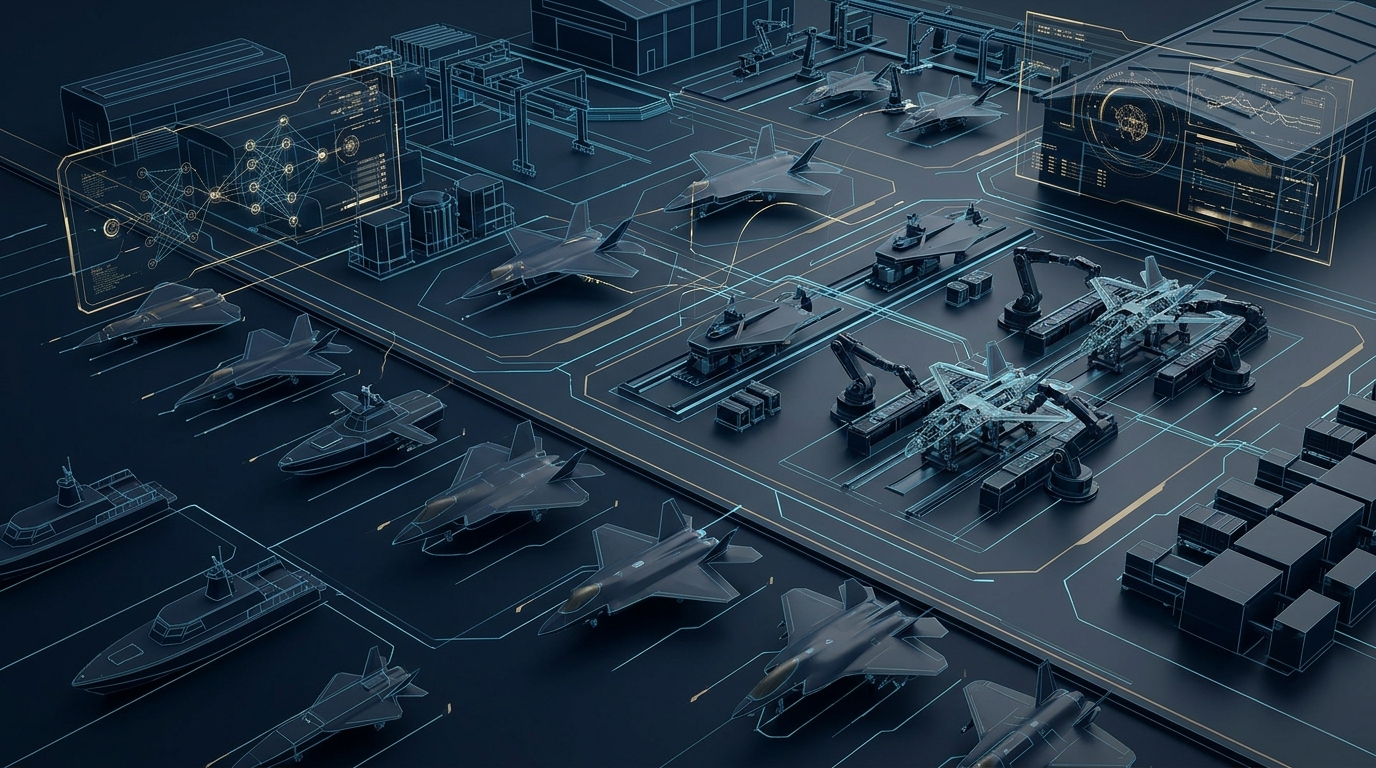
The contemporary defense-technology ecosystem is no longer an amorphous collection of venture-backed experiments. It has structured itself into a vertically integrated sovereign stack: frontier foundation models at the apex, operational data and command-and-control software beneath them, autonomous kinetic platforms at the tactical edge, and a heavily automated domestic manufacturing base anchoring physical volume underneath everything.
The Four Pillar Hypotheses#
- ▸Software Has Become Sovereign Mission Infrastructure: Legacy weapons systems treat software as a secondary procurement item packaged inside expensive hardware. In the new paradigm, software is the operational core. Palantir’s Maven and Vantage architectures, Scale AI’s secure training and evaluation pipeline, and frontier LLM deployments across classified and IL5 defense enclaves demonstrate that data orchestration and cognitive speed dictate theater superiority.
- ▸Autonomy Inverts the Kinetic Cost Curve: Traditional defense doctrine deploys multi-million-dollar exquisite interceptors against asymmetric threats. Challengers like Anduril, Shield AI, Helsing, Saronic, and Applied Intuition decouple capability from bespoke hardware by running reusable autonomy software across standardized, attritable air, surface, and undersea platforms.
- ▸Private Venture Capital Is Underwriting Readiness: By deploying private capital into physical production capacity prior to receiving guaranteed government purchase orders—epitomized by Anduril’s Arsenal-1, Saronic’s Port Alpha shipyard, Castelion’s Project Ranger test complex, and Hadrian’s precision automated manufacturing hubs—the cohort shifts capital expenditure risk from taxpayer budgets to private equity. In return, the military secures rapid delivery cycles.
- ▸Acquisition Policy Has Structurally Adapted to Commercial Speed: Through the formal adoption of the Software Acquisition Pathway, aggressive expansion of Other Transaction Authority (OTA) agreements, the scaling of the Defense Innovation Unit (DIU), and sweeping enterprise contract consolidations, the Department of Defense is systematically dismantling the multi-year Federal Acquisition Regulation (FAR) barriers that historically insulated legacy primes from commercial competition.
02. Why the Door Opened: The Structural Acquisition Shift#
Between 1970 and 2022, the Pentagon's procurement architecture functioned primarily as a risk-averse, cost-plus accounting apparatus designed to manage five entrenched prime contractors: Lockheed Martin, Boeing, Northrop Grumman, General Dynamics, and RTX. This apparatus produced world-class engineering across decades, but proved structurally incapable of iterating software at commercial speed or generating high-volume, low-cost attritable mass.
The demand signal has now transitioned from experimental pilots to statutory, institutional procurement:
The Institutional Catalysts#
- ▸Software First Acquisition Policy: On March 6, 2025, the Secretary of Defense issued a binding policy memorandum designating the Software Acquisition Pathway as the default mechanism for all software systems embedded within weapons architectures and enterprise management systems. The directive mandated Commercial Solutions Openings (CSOs) and Other Transactions (OTs) as the primary contracting routes, explicitly curtailing legacy cost-plus contracting models.
- ▸Defense Innovation Unit (DIU) Scaling: Following historic budget expansions, DIU’s FY24 appropriation reached $983 million—nearly a ten-fold increase over historical appropriations. Operating with reported FY26 resources near $979 million, DIU executes prototype OTA awards within 60 to 90 days from problem solicitation, bypassing multi-year FAR competition windows.
- ▸CDAO as Enterprise AI Integrator: The Chief Digital and Artificial Intelligence Office (CDAO) has emerged as the Pentagon's centralized enterprise software clearinghouse. Beyond issuing $200 million ceiling prototype OTAs to four leading frontier-AI labs (Anthropic, Google, OpenAI, xAI), CDAO raised Scale AI’s production agreement from $100 million to $500 million, and integrated GenAI.mil across 1.5 to 1.7 million active defense personnel by mid-2026.
- ▸Institutionalized Mass Autonomy: The Replicator initiative, originally launched as a rapid prototyping exercise, evolved into permanent bureaucratic infrastructure: JIATF-401 and the 2026 Direct Reporting Program Manager for Unmanned Systems (DRPM-UxS). Backed by an estimated $75 billion portfolio, this entity is tasked with procuring and fielding over 200,000 attritable uncrewed systems by 2027.
03. The Field: Strategic Matrix by Mission Layer#
The defense-tech landscape features a spectrum of companies addressing specific bottlenecks across the software, platform, and industrial layers.
| Rank | Company | Operational Domain | Strategic Mission Focus | Core Platform / Architectural Contribution | Landmark Contract / Valuation Signal |
|---|---|---|---|---|---|
| 01 | Palantir | AI + Operational Data | Decision advantage & targeting | Maven Smart System, Vantage Data Platform, AIP | $1.3B Maven ceiling; $10B Army Enterprise Agreement |
| 02 | Anduril | Autonomy + Industrial Base | Software-defined platforms & C2 | Lattice OS, FQ-44A Fury CCA, Dive-LD, Arsenal-1 | $20B Army ceiling; FQ-44A USAF production order; $61B val |
| 03 | Anthropic | Frontier AI + Safety | High-assurance reasoning & cyber | Claude Gov, Constitutional AI, interpretability tooling | $200M CDAO ceiling; classified network deployment |
| 04 | Scale AI | AI Infrastructure & Data | MLOps, evaluation, and fine-tuning | Thunderforge planning suite, Donovan MLOps pipeline | CDAO production OTA expanded 5× to $500M |
| 05 | Shield AI | Tactical Autonomy | GPS-denied aircraft maneuvering | Hivemind autonomy stack, V-BAT 128 VTOL UAS | Reported $800M Navy ISR award; $12.7B valuation |
| 06 | Helsing | Autonomy + Software Defense | European sovereign defense stack | Altra recon-strike, Cirra EW AI, HX-2 loitering munition | $18B Series E valuation; €1.46B Bundeswehr HX-2 framework |
| 07 | Castelion | Industrial Manufacturing | Low-cost hypersonic strike | Blackbeard strike missile, Project Ranger factory | Up to $200M Navy production order; $13B valuation |
| 08 | Saronic | Maritime Autonomy + Shipyards | Autonomous naval surface vessels | Corsair 24-ft USV, Spyglass 6-ft USV, Port Alpha shipyard | $392M Navy Corsair contract; $9.25B valuation |
| 09 | Hadrian | Advanced Manufacturing | Precision factories-as-a-service | Automated multi-axis CNC cells, Cherokee factory | Reported $900M Navy submarine award; $7.87B valuation |
| 10 | Epirus | Directed Energy Autonomy | Counter-swarm electromagnetic denial | Leonidas software-defined high-power microwave (HPM) | $66.1M Army prototype contract; zero-marginal-cost kill |
| 11 | Applied Intuition | Ground Autonomy Tooling | Vehicle autonomy simulation & testing | Automotive-grade synthetic simulation, drive-by-wire robotics | Autonomous squad vehicle in 10 days; $15B valuation |
| 12 | OpenAI + xAI | Enterprise Generative AI | Department-wide general intelligence | ChatGPT Mil, Grok for Government, classified LLM pipelines | GenAI.mil at IL5 across 1.7M users; $200M CDAO ceilings |
04. Three Firms Defining the Sovereign Model#
Three prime-scale entities demonstrate how software cadence, commercial-style R&D, and private capital expenditure alter defense capabilities.
Anthropic: High-Assurance Frontier AI and the Contested Supply Chain#
Anthropic established early technical leadership by positioning model interpretability and Constitutional AI safeguards as national-security assets rather than commercial limitations.
- ▸CDAO Frontier-AI Prototype OTA (July 2025): Anthropic was selected as one of four labs awarded a prototype transaction under an overarching $200 million ceiling, supporting intelligence synthesis, automated vulnerability analysis, and joint operational planning.
- ▸Classified Deployments (Claude Gov + Palantir + AWS): Anthropic announced it became the first AI lab to deploy frontier models directly into classified U.S. national security networks in June 2024. Operating within AWS Secret and Top Secret GovCloud enclaves integrated with Palantir AIP, Claude provided analytical reasoning over compartmented intelligence streams.
- ▸Tri-Tier Safety Architecture: Anthropic structured its defense posture across three verification layers: (1) model-level safety fine-tuning, (2) automated runtime monitoring for prompt misuse, and (3) enforceable contractual usage bounds. The company progressively permitted weapons design simulation, offensive cyber operations, and foreign intelligence analysis, while maintaining strict prohibitions against lethal autonomous weapons targeting and domestic mass surveillance.
- ▸The Supply-Chain Risk Dispute: On March 3, 2026, the Department of Defense designated Anthropic a supply-chain risk after the company refused to remove contractual limitations and accept "all lawful defense uses." On September 25, 2026, a D.C. Circuit Court of Appeals panel voted 2–1 to uphold the Pentagon's administrative exclusion authority. Concurrently, reporting indicates a separate California federal court injunction against the government remained operative, creating an unresolved jurisdictional conflict across federal circuits.
Palantir: The Operating System of the American Arsenal#
Palantir has transitioned from an enterprise data integration vendor into the operational software prime for the Department of Defense and allied militaries.
- ▸Maven Smart System ($1.3B Ceiling): Designated an official Program of Record in March 2026, Project Maven's software baseline serves as the automated sensor-to-shooter data fabric for INDOPACOM and CENTCOM. The platform generates an estimated $1 billion in annual recurring revenue (ARR) for Palantir.
- ▸U.S. Army Enterprise Agreement ($10B Ceiling): A landmark 10-year enterprise agreement consolidating 75 disparate data management and analytical contracts. Palantir’s remaining total U.S. government performance obligation reached $11.8 billion by mid-2026.
- ▸Army Vantage Operational Backbone ($618.9M Ceiling): Serving over 100,000 military personnel, Vantage unifies personnel readiness, munitions logistics, supply-chain risks, and global troop movements into a single operational interface.
- ▸Financial Velocity: In Q2 2026, Palantir reported U.S. government revenue of $809 million (+90% YoY), driving total quarterly revenue to $1.94 billion (+93% YoY) with an 84.8% gross margin.
- ▸Allied Friction & European Scrutiny: Despite its American dominance, Palantir faces headwinds in Europe. In September 2026, a coalition of 125 European civil-liberties and defense organizations petitioned European ministries to terminate Palantir software agreements due to vendor lock-in and sovereignty risks, while the UK National Health Service data platform contract remains politically challenged.
Anduril: The Vertically Integrated Hardware-Software Prime#
Anduril represents the first venture-backed defense challenger since World War II to compete head-to-head with legacy primes and secure production mandates on major aerial combat programs.
- ▸USAF FQ-44A Fury CCA Ordered into Production (June 2026): In a historic departure from legacy development timelines, the U.S. Air Force ordered both Anduril’s FQ-44A Fury and General Atomics' FQ-42A into low-rate initial production four months ahead of schedule. The program targets the procurement of over 150 Collaborative Combat Aircraft by 2030, operating as autonomous wingmen to fifth- and sixth-generation fighters.
- ▸$20B Army Enterprise Contract Vehicle: A 10-year indefinite-delivery/indefinite-quantity (IDIQ) contract consolidating more than 120 separate procurement actions. The first task order, valued at $87 million, established Anduril's Lattice OS as the command-and-control backbone for the Army's counter-uncrewed aerial systems (C-UAS) network.
- ▸Arsenal-1 Gigafactory (Pickaway County, OH): Backed by a $910.5 million corporate capital commitment, Anduril constructed a 5-million-square-foot automated manufacturing facility across 500 acres. Operational since March 2026, the facility completed its first production-standard FQ-44A rollout on July 27, 2026, designed to scale toward an annual output capacity of 150 tactical aircraft.
- ▸Capital Base: Anduril closed a $5 billion Series H financing round on May 13, 2026, establishing a post-money valuation of $61 billion. The company generated approximately $2.2 billion in 2025 revenue, more than doubling year-over-year.
- ▸Execution Risk: The unit price and contract value for the initial CCA production lot remain classified. Anduril’s self-funded capital expenditures resulted in a reported $1.2 billion operating loss in 2026, making automated factory yield and unit production economics the central test of the company's financial model.
05. The Specialist Bench: Targeted Industrial Bottlenecks#
Beyond the three market anchors, ten specialized entrants are resolving specific physical and algorithmic bottlenecks:
Scale AI: The Operational MLOps Pipeline#
Scale AI has secured the data engineering and algorithmic evaluation layer of the Department of Defense. As the prime contractor on DIU’s March 2025 Thunderforge prototype—partnered with Anduril (Lattice) and Microsoft (Azure Government)—Scale deployed automated courses-of-action generation and red-teaming simulations for INDOPACOM and EUCOM operational staffs. In May 2026, CDAO expanded Scale AI’s production Other Transaction Authority agreement from $100 million to $500 million after demand exceeded initial vehicle capacity, positioning its Donovan platform across unclassified, Secret, and Top Secret/SCI domains.
OpenAI + xAI: General-Purpose Intelligence at Enterprise Scale#
OpenAI formalized its defense footprint via OpenAI for Government in June 2025, winning a $200 million CDAO prototype OTA and executing classified network deployment agreements in February 2026. On August 31, 2026, ChatGPT Mil was formally integrated into the DoD’s GenAI.mil platform at Impact Level 5 (IL5), operating in air-gapped enclaves designed to prevent defense data from training commercial models. Concurrently, xAI deployed Grok for Government on GenAI.mil, offering real-time open-source intelligence analysis and sentiment tracking derived from X telemetry, though model hallucination and content-safety controls remain subjects of ongoing evaluation.
Shield AI: GPS-Denied Edge Flight Autonomy#
Shield AI’s Hivemind autonomy stack—comprising EdgeOS, Pilot, Commander, and Forge—provides autonomous flight and tactical maneuvering without reliance on GPS or external communications links. Hivemind has been licensed by eight of the top 25 U.S. defense primes for integration on third-party airframes. Its organic platform, the V-BAT 128 vertical takeoff and landing (VTOL) drone, completed over 130 combat sorties in the Ukraine theater since June 2024. Shield AI raised $2 billion at a $12.7 billion post-money valuation in March 2026, bolstered by a reported $800 million Navy contractor-operated ISR service contract.
Helsing: European Sovereign AI Defense#
Operating as Europe’s premier defense-technology unicorn, Helsing raised a $1.8 billion Series E at an $18 billion valuation in July 2026. The firm’s architecture combines the HX-2 loitering strike drone, Altra autonomous sensor-to-shooter recon software, Cirra cognitive electronic warfare AI, and Centaur autonomous fighter software. Helsing secured an initial €269 million contract with the German Bundeswehr for HX-2 systems, accompanied by a framework option scaling to €1.46 billion. In Ukraine, over 6,000 HX-2 drones have been contracted and 4,000 HF-1 electronic warfare systems delivered, with Helsing acting as a software partner to European primes including Saab, Rheinmetall, Kongsberg, and Airbus.
Castelion: Mass-Produced Low-Cost Hypersonics#
Founded to dismantle the multi-million-dollar cost structure of precision strike weapons, Castelion completed more than 25 flight tests of its Blackbeard hypersonic strike missile in under three years. In September 2026, the U.S. Navy awarded Castelion a low-rate production contract valued at up to $200 million. Castelion targets an operational unit production cost of $384,000 per round, compared to more than $3.0 million for legacy Long-Range Anti-Ship Missiles (LRASM). Production is anchored at Project Ranger, a privately funded 1,000-acre automated manufacturing facility in New Mexico.
Saronic: Software-Defined Naval Surface Warfare#
Saronic addresses the critical deficit in U.S. naval shipbuilding through automated, serial production of autonomous surface vessels (ASVs). In 2026, the company secured a $392 million Navy manufacturing contract for its 24-foot Corsair autonomous vessel. Supported by a planned $3 billion+ private investment in Port Alpha (Brownsville, TX), Saronic produces vessels ranging from the 6-foot Spyglass to the 180-foot Marauder, controlled via its proprietary Echelon multi-agent fleet software. In September 2026, Saronic expanded into crewed naval construction through an OTA prototype award for the Navy's LCU-1700 landing craft replacement.
Epirus: Inverting the Swarm Cost-Exchange Ratio#
As low-cost commercial drone swarms render traditional missile interceptors economically non-viable, Epirus deployed Leonidas, a software-defined high-power microwave (HPM) counter-electronics system. Backed by a $66.1 million Army prototype development contract, Leonidas uses solid-state gallium nitride (GaN) power amplifiers to emit targeted radio frequency energy that disables electronic control systems across swarms simultaneously, reducing the marginal engagement cost to the electrical energy consumed.
Applied Intuition: Commercial Automotive Scale for Defense Autonomy#
Leveraging simulation platforms utilized by 18 of the world’s top 20 automotive OEMs, Applied Intuition expanded aggressively into tactical ground robotics. In an Army prototype demonstration, the company converted a standard Infantry Squad Vehicle from a bare chassis into a fully autonomous, obstacle-navigating platform in 10 days, deploying modular drive-by-wire robotics and synthetic physics modeling. The company reached a $15 billion valuation following a $600 million financing round and tender in June 2025.
Hadrian: Factories-as-a-Service for Precision Aerospace#
Hadrian secured a $1.37 billion Series D at a $7.87 billion valuation in August 2026 to scale its software-orchestrated machining factories. Addressing severe lead-time bottlenecks across rocket engines, satellite components, and naval construction, Hadrian automated multi-axis precision CNC machining to compress part lead times from months to days. Hadrian’s new Cherokee, Alabama manufacturing campus was anchored by a reported $900 million Navy contract for critical nuclear submarine components.
Vannevar Labs + Rebellion Defense: Edge Software & Analytical Synthesis#
Vannevar Labs’ flagship platform, Decrypt, employs specialized natural language processing and LLMs to monitor non-traditional foreign signals and battlefield electromagnetic emissions, operating under a November 2024 DIU production agreement with a $99 million ceiling. Rebellion Defense’s Iris and Nova platforms provide automated adversary emulation and mission-planning graph synthesis across classified enterprise networks as an awardable vendor under the CDAO Tradewinds marketplace.
06. Market Lens: What Private Capital Is Pricing In#
Venture capital and public equity markets are valuing defense-tech entrants at unprecedented multiples relative to legacy primes. Investors are pricing these companies not as cyclical manufacturing contractors, but as high-margin, scalable enterprise software businesses paired with automated industrial production.
| Entity | Valuation / Market Capitalization | Revenue Multiple Benchmark | Primary Investment Thesis |
|---|---|---|---|
| Palantir | Public (~$150B+ Enterprise Value) | ~75× Forward Sales | Near-monopolistic command data lock-in; +90% USG revenue growth; ~$1B Maven ARR; 84.8% gross margin. |
| Anduril | $61.0B (Series H, May 2026) | ~28× 2025 Revenue | Vertical integration across hardware and Lattice OS; FQ-44A CCA production prime; industrial scale at Arsenal-1. |
| Helsing | $18.0B (Series E, July 2026) | High Growth Multiple | Sole sovereign European software prime; €1.46B Bundeswehr framework; Ukraine battlefield validation. |
| Applied Intuition | $15.0B (Series F, June 2025) | Commercial Scale Multiple | Simulation software dominance across automotive primes applied directly to military autonomy. |
| Castelion | $13.0B (Venture Valuation) | Forward Production Bet | Sub-$400k hypersonic weapon production; $200M Navy order; automated serial production at Project Ranger. |
| Shield AI | $12.7B (March 2026; talks @ $20B+) | Software IP Multiplier | Hivemind autonomy operating as the industry standard across 8 of top 25 defense primes. |
| Saronic | $9.25B (Venture Valuation) | Maritime Infrastructure Multiple | Restoring American maritime mass through automated shipbuilding at Port Alpha + Echelon fleet C2. |
| Hadrian | $7.87B (Series D, August 2026) | Industrial Infrastructure Multiple | Automated precision factory-as-a-service eliminating submarine and missile supply-chain bottlenecks. |
| Lockheed Martin | Public (~$115B Market Cap) | ~1.8× Sales | Legacy Reference: Exquisite hardware manufacturing; single-digit revenue growth; cost-plus margin ceilings. |
07. The Strategic Watchlist: Forward Horizon & Failure Modes#
To determine whether the defense-tech cohort maintains its structural trajectory or succumbs to capital-intensive execution traps, defense leadership and allocators must monitor six operational failure modes:
The Six Operational Watch Items#
- ▸Ceiling-to-Revenue Conversion Ratios: Indefinite-delivery/indefinite-quantity (IDIQ) and enterprise contract ceilings—such as Anduril’s reported $20 billion Army ceiling and Palantir’s $10 billion agreement—represent maximum spending authorizations, not obligated outlays. Allocators must track actual funded task order drawdowns, delivery-order cadence, and appropriations line items rather than headline press figures.
- ▸Factory-Floor Yield, Scrap Rates, and Unit Economics: Anduril (Arsenal-1), Saronic (Port Alpha), Castelion (Project Ranger), and Hadrian operate on the premise that automotive-style automation can produce military-grade systems at 70% lower costs. If scrap rates in precision composites, rocket motors, or marine hulls fail to decline at scale, these capital-intensive investments will generate severe corporate liquidity stress.
- ▸Model Assurance, Alignment, and Legal Defense Standards: The administrative exclusion of Anthropic following its refusal to remove contractual prohibitions on lethal autonomous weapons marks the beginning of policy confrontation between frontier-AI safety mandates and military operational demands. Watch for the emergence of standardized DoD evaluation metrics for LLM hallucination in targeting chains and legal frameworks governing autonomous lethal action.
- ▸Platform Openness vs. Proprietary Enclosure: As Anduril’s Lattice and Palantir’s Maven expand, the Department risks substituting a five-prime legacy hardware monopoly with a two-prime proprietary software monopoly. The Pentagon must enforce modular open systems architecture (MOSA) compliance, ensuring third-party hardware and niche models can interface with Lattice or Maven without licensing friction.
- ▸Operational Combat Telemetry vs. Marketing Claims: Secondary reporting from Eastern Europe and the Middle East frequently conflates pilot deployments with battlefield success. Rigorous, unvarnished after-action combat reports—measuring autonomous target acquisition rates in heavy EW environments, jammer survival, and interceptor kill ratios—are required to separate true capability from promotional claims.
- ▸Statutory Durability Beyond Executive Memoranda: Current acquisition velocity relies heavily on executive orders and departmental directives promoting the Software Acquisition Pathway and OTA flexibilities. The durability of this paradigm depends on whether congressional armed services committees codify these authorities in future National Defense Authorization Acts (NDAAs) despite legacy prime lobbying.
08. Sources & Empirical Methodology#
Methodological Architecture: This dossier represents a fixed analytical snapshot derived from an exhaustive multi-source research run concluded on October 3, 2026 UTC. In accordance with Tresslers Group intelligence protocols, all company-reported figures, secondary press claims, and official DoD public contract awards are explicitly distinguished. Dollar ceilings represent theoretical maximum contract capacity under indefinite-delivery vehicles rather than guaranteed Treasury disbursements.
- ▸
[01]Nextgov / Federal Acquisition Reporting (March 2025): Pentagon Aims to Accelerate Acquisition of New Tech Through Software Contracting Change. Official reporting on SecDef policy memorandum designating Software Acquisition Pathway and Commercial Solutions Openings as primary mechanisms. Link - ▸
[02]Big Story Network / Defense Analysis (July 2025): Pentagon Awards AI Prototype Deals to Frontier Labs. Analysis of CDAO prototype transaction agreements issued to Anthropic, Google, OpenAI, and xAI with $200M individual ceilings. Link - ▸
[03]Homeland Security Digital Library (HSDL) (June 2024): Classified Enclave Deployment of Frontier Cognitive Architectures. Documentation of Anthropic Claude Gov deployment into AWS Secret GovCloud integrated with Palantir AIP. Link - ▸
[04]BigGo Finance & Regulatory Disclosures (August 2026): Palantir Technologies Q2 2026 Earnings & U.S. Army Enterprise Agreement. Financial audit of Palantir’s $10B Army contract consolidation, $1.3B Maven Smart System ceiling, and $809M quarterly USG revenue. Link - ▸
[05]Business Wire / Palantir Official Release (December 2024): Palantir Expands Army Vantage Partnership with $618.9M Contract. Formal contract announcement for the continuation of the Army Data Platform serving 100,000+ users. Link - ▸
[06]Techstrong IT / European Digital Rights (September 2026): European Coalition Calls for Governments to Cancel Palantir Contracts. Account of 125 civil society and technology organizations contesting European public-sector defense and healthcare deployments. Link - ▸
[07]Congressional Research Service (CRS) (Updated 2026): The Replicator Initiative and Defense Unmanned Systems. In Focus report IF12611 analyzing the transition from Replicator to JIATF-401 and DRPM-UxS portfolio administration. Link - ▸
[08]The War Zone (June 2026): USAF Orders Both General Atomics FQ-42 and Anduril FQ-44 into Production. Comprehensive defense analysis of Collaborative Combat Aircraft (CCA) Increment 1 low-rate initial production orders. Link - ▸
[09]Manufacturing Magazine (July 2026): Anduril Arsenal-1: Pickaway County Mega-Plant Redefines Defense Production. Industrial analysis of Anduril’s $910.5M, 5M sq ft Ohio manufacturing facility and first aircraft rollout. Link - ▸
[10]Defense Innovation Unit (DIU) (March 2025): DIU's Thunderforge Project to Integrate Commercial AI-Powered Decision-Making. Official release detailing Scale AI prime contract award alongside Anduril Lattice and Microsoft. Link - ▸
[11]Washington Technology (May 2026): DoD Grows Scale AI Agreement to $500M. Analysis of CDAO’s decision to expand Scale AI’s production Other Transaction Authority agreement from $100M to $500M. Link - ▸
[12]WebProNews (August 2026): Pentagon Deploys ChatGPT Mil and Grok for Government to Millions of Troops. Coverage of GenAI.mil reaching 1.7M military personnel at Impact Level 5 via OpenAI and xAI enclaves. Link - ▸
[13]Defense News (July 2026): Helsing Raises $1.8 Billion in Europe's Biggest Defense-Startup Round. Reporting on Helsing’s $18B Series E valuation, Bundeswehr HX-2 contracts, and prime software partnerships. Link - ▸
[14]SOFX (September 2026): Navy Hands Castelion $200M Deal to Mass-Produce Hypersonic Missiles. Technical breakdown of Castelion Blackbeard strike missile testing cadence and Project Ranger industrial facility. Link - ▸
[15]New Atlas (2025–2026): U.S. Army Awards Contract for Leonidas High-Power Microwave Weapon Against Drone Swarms. Analysis of Epirus $66.1M contract for GaN-based counter-electronics systems. Link - ▸
[16]TechCrunch (June 2025): Applied Intuition Raises $600 Million as It Pushes Further into Defense. Examination of automotive autonomy tooling, drive-by-wire robotics, and the 10-day autonomous vehicle conversion demo. Link - ▸
[17]Washington Technology (August 2026): Hadrian Fetches $1.37B to Add More Automation-Intensive Factories. Details on Hadrian’s Series D valuation ($7.87B) and reported $900M Navy submarine precision parts contract in Cherokee, AL. Link - ▸
[18]Defense News (December 2024): Anduril, OpenAI Join to Boost Counter-Drone Tech for U.S. Bases, Troops. Industry analysis of generative and edge AI integration into Lattice command-and-control networks. Link - ▸
[19]SaveDelete Legal Analysis (September 2026): Anthropic Pentagon Appeals Ruling: Jurisdictional Conflict in Supply Chain Risk. Legal examination of D.C. Circuit 2–1 affirmation vs. California District Court injunction on national security AI exclusion. Link