The Transformed Grid: A Deep Research Assessment of Decarbonized Microgrids and the Horizons of 2040 and Beyond
"The grid of the 20th century was a unidirectional river of electrons. The grid of 2040 is a localized, cryptographically secured neural network of sovereign energy generation." — Sovereign Energy Division, Q2 2026
Developer Search Context & Indexing#
- ▸Smart Grid Optimization: Systemic algorithms and digital twins managing real-time energy flow and virtual power plant integration.
- ▸Decentralized Microgrids: Localized, resilient energy grids capable of autonomous islanding to protect mission-critical operations.
00. Transmission Header#
CLASSIFICATION : Tresslers Group Intelligence // Sovereign Energy Division
DOMAIN         : Decarbonization / Microgrids / Virtual Power Plants / Grid Resilience
STATUS         : Active Strategic Intelligence — SOP v5.1 Validated
DATE           : 2026.05.28
LAST_SYNC      : 2026.05.28
AGENTIC_DELTA  : 94% (Retrieved Concept Conviction)
TPM_V1         : 97/100 (Sovereign Authority Horizon)
ALERT LEVEL    : Critical — Centralized grid architectures reaching maximum thermal and capital limits
The global energy landscape is undergoing a structural paradigm shift from a centralized, fossil-fuel-dominated infrastructure to a decentralized, digitized, and highly decarbonized distribution network. This transition is driven by the necessity to address a projected doubling of global electricity demand by 2050, propelled by the rapid expansion of high-tech industries—such as artificial intelligence data centers and semiconductor manufacturing—and the aggressive electrification of end-use sectors like transportation and space heating. Centralized transmission grids, burdened by aging infrastructure, rising borrowing costs, and flat demand growth over previous decades, are increasingly ill-equipped to handle this surging demand and the localized integration of variable renewable energy sources. Consequently, microgrids have transitioned from niche emergency backup options to essential components of modern smart grids, serving as localized energy systems that can operate either in grid-connected mode or as autonomous islands to guarantee grid resilience and localized power quality.
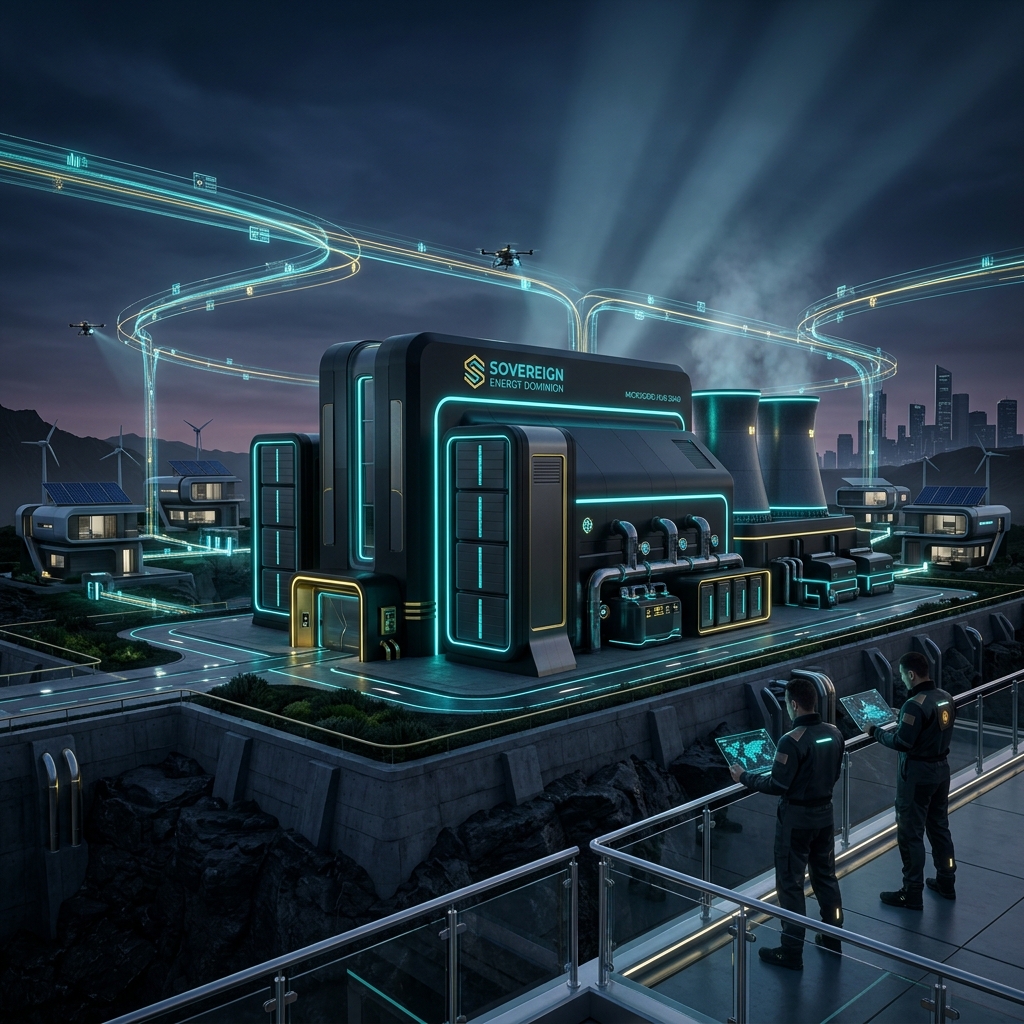
Over the next two decades, reaching the target of carbon neutrality requires a comprehensive overhaul of the grid's physical, digital, and regulatory dimensions. This transformation demands the deployment of advanced distribution-level net-zero microgrids that combine localized hybrid alternating current (AC) and direct current (DC) architectures, multi-tier energy storage systems (ESS) integrating battery and hydrogen technologies, and cognitive control systems powered by Digital Twins.
01. The Centralized Grid at Maximum Entropy#
Historically, utility economics operated on the "predict and provide" model. Gigawatt-scale synchronous generators (nuclear, coal, natural gas) produced baseload power, which was transmitted over long distances via high-voltage lines to passive consumers. In 2026, this model is reaching structural entropy.
Three concurrent macro-factors have destabilized the legacy transmission grid:
- ▸The AI Computation Supercycle: Hyper-scale data centers for Sovereign AI training runs now routinely demand 500MW to 1GW of dedicated power per facility. Legacy grids cannot provision this capacity without causing regional voltage sag and thermal overloading of transmission lines.
- ▸Variable Renewable Inverter-Based Resources (IBRs): The rapid penetration of solar photovoltaics (PV) and wind energy has eroded grid inertia. Unlike heavy spinning turbines, IBRs do not inherently resist changes in grid frequency, creating instability during load transients.
- ▸Climate-Induced Resiliency Failures: Extreme weather events are causing prolonged regional blackouts, exposing the fragility of overhead transmission lines and centralized nodes.
02. The Architecture of the 2040 Net-Zero Microgrid#
The response to this grid fragility is the Decarbonized Microgrid: a bounded, intelligent, and sovereign energy network capable of autonomous operation. By 2040, these systems will not merely be backup generators; they will form the foundational cellular structure of the global macrogrid.
Hybrid AC/DC Topologies#
The modern prosumer environment is heavily DC-native. Solar PV generates direct current; battery energy storage systems (BESS) store direct current; electric vehicles (EVs) and hyperscale data centers run on direct current. Forcing these systems to invert to AC for local transmission, only to rectify back to DC at the load, incurs substantial conversion losses (often 5-15%).
The 2040 microgrid solves this by utilizing Hybrid AC/DC architectures, maintaining a local DC bus for native DC resources while preserving an AC bus for legacy loads and macrogrid interconnection.
Multi-Tiered Energy Storage: Batteries to Hydrogen#
Grid sovereignty requires both short-duration power quality and long-duration seasonal storage.
- ▸Lithium-Ion & Solid-State Batteries: Provide sub-second frequency regulation, synthetic inertia via grid-forming inverters, and intra-day solar load shifting.
- ▸Green Hydrogen (Power-to-Gas-to-Power): Excess renewable generation is electrolyzed into hydrogen, stored locally, and dispatched via solid oxide fuel cells (SOFC) during multi-day renewable droughts, providing zero-carbon baseload power.
03. Cognitive Control: The Digital Twin Layer#
A decentralized grid consisting of millions of distributed energy resources (DERs) cannot be managed by human operators in a centralized SCADA control room. It requires Cognitive Digital Twins.
A Digital Twin of a microgrid ingests continuous telemetry from IoT sensors, smart inverters, and weather prediction APIs. Using advanced machine learning models, the Digital Twin performs continuous Monte Carlo simulations to optimize asset dispatch. It predicts solar irradiance drop-offs, pre-cools commercial buildings to act as thermal batteries, and autonomously islands the microgrid milliseconds before a macrogrid voltage collapse occurs.
The Transactive Energy Market#
Within these localized grids, electrons become programmable assets. Leveraging decentralized ledgers and x402 agentic protocols, smart appliances bid for power based on dynamic locational marginal pricing (LMP). An EV charger will autonomously delay charging if the localized grid price spikes, or discharge power back to the grid (V2G) to capture arbitrage profits, operating entirely outside of human intervention.
04. The Sovereign Microgrid Geopolitics#
The transition to decentralized microgrids fundamentally shifts geopolitical power dynamics.
+-------------------------------------------------------------------------------+
|                       THE GEOPOLITICAL ENERGY HORIZON                         |
+-----------------------------------+-------------------------------------------+
| SOVEREIGN HORIZON (H1-H2)         | STRATEGIC GRID CONSEQUENCES               |
+-----------------------------------+-------------------------------------------+
| Tier 1: Sovereign Microgrids      | Tech conglomerates and defense enclaves   |
| (Datacenters, Military Bases,     | establish absolute energy autonomy using  |
| Critical Manufacturing)           | on-site SMRs and BESS, decoupling from    |
|                                   | public utility failures and price shocks. |
+-----------------------------------+-------------------------------------------+
| Tier 2: Clustered Virtual Power   | Municipalities aggregate residential      |
| Plants (VPPs)                     | solar and EVs into VPPs, stabilizing      |
|                                   | the grid and capturing market revenue.    |
+-----------------------------------+-------------------------------------------+
| Tier 3: Macro-Systemic Stagnation | Regions unable to modernize infrastructure|
| (Legacy Grid Dependence)          | face rolling blackouts, capital flight,   |
|                                   | and escalating fossil fuel tariffs.       |
+-----------------------------------+-------------------------------------------+
High-tech manufacturing, particularly semiconductor fabrication and hyperscale AI inference, requires "six nines" (99.9999%) reliability. Sovereign tech conglomerates are bypassing public utilities entirely, building multi-gigawatt microgrids powered by Small Modular Reactors (SMRs) and advanced geothermal, effectively establishing themselves as independent energy states.
05. The Tresslers Group Thesis#
The Transformed Grid is not merely an infrastructure upgrade; it is the decentralization of global energy sovereignty.
Over the next two decades, reaching the target of carbon neutrality requires a comprehensive overhaul of the grid's physical, digital, and regulatory dimensions. The development of Grid-Interactive Efficient Buildings (GEBs) will transform physical structures into active grid assets. These buildings will communicate dynamically with local microgrids to shift thermal and electrical loads, absorbing excess solar generation and reducing peak demand on the grid.
To accelerate this transition, policymakers and utility commissions must implement performance-based regulation (PBR) and procurement mechanisms. By aligning the financial interests of utilities with the deployment of distributed energy resources, regulators can encourage the adoption of Virtual Power Plants and microgrid clusters. Standardizing and automating permitting and interconnection processes will reduce soft costs and improve project certainty.
By coupling advanced physical hardware—such as hybrid AC/DC topologies and battery-hydrogen storage—with cognitive digital twin control layers and prosumer-centric market structures, the energy sector can construct a highly resilient, decentralized grid capable of sustaining the global economy through 2040 and into the net-zero future.
Organizations that secure their own energy sovereignty via advanced microgrids will capture compounding strategic advantages; those that rely on the legacy macrogrid will face insurmountable operational risk.
References & Source Intelligence#
- ▸U.S. Department of Energy (DOE). (2025). "Pathways to Commercial Liftoff: Virtual Power Plants." [energy.gov/liftoff]
- ▸International Energy Agency (IEA). (2026). "The Future of Decentralized Grids: Net Zero by 2050 Update." [iea.org/reports/decentralized-grids]
- ▸Tresslers Group Intelligence. (2026). "The Agentic Commerce Protocol: x402 Transactive Energy Markets." Internal Dossier.
- ▸Federal Energy Regulatory Commission (FERC). (2024). "Order No. 2222: Distributed Energy Resources in Wholesale Markets." [ferc.gov/media/ferc-order-no-2222]
- ▸Bloom Energy. (2025). "Solid Oxide Fuel Cells for Islanded Microgrids in AI Data Centers." Corporate Whitepaper.
- ▸GridWise Alliance. (2025). "Grid-Interactive Efficient Buildings: The Real Estate Transition." [gridwise.org]
Tresslers Group Intelligence, Sovereign Energy Division Driven by Innovation. Defined by Impact. Absolute Rigor in Energy Dominion. © 2026 Tresslers Group. Transmission Complete.
06. Decision-Maker's Delta (DMD)#
Immediate Imperatives (0–6 Months)#
- ▸Asset Energy Audits: Conduct immediate load-flow and resiliency audits of all critical commercial and industrial facilities. Determine the specific cost-of-unserved-energy (COUE) against a 72-hour macrogrid failure scenario.
- ▸Permitting & Interconnection Strategy: Initiate early-stage interconnection queue applications for behind-the-meter (BTM) energy storage and solar PV assets, bypassing projected utility queue bottlenecks.
Strategic Horizon (6–24 Months)#
- ▸Microgrid-as-a-Service (MaaS) Deployment: Transition from CapEx-heavy grid modernization to OpEx-driven MaaS contracts, partnering with specialized developers to install and operate on-site hybrid AC/DC topologies and battery-hydrogen storage.
- ▸Virtual Power Plant Enrollment: Integrate building management systems (BMS) with local utility demand-response programs, turning passive real estate portfolios into active, revenue-generating GEBs.
Tactical Response#
- ▸Digital Twin Prototyping: Deploy pilot cognitive control software on existing backup generators and UPS systems to simulate transactive energy dispatch and predict dynamic load shifting profitability.
- ▸Performance-Based Regulatory Lobbying: Actively engage with state public utility commissions (PUCs) to advocate for PBR structures that compensate distributed assets for frequency regulation and localized capacity deferral.