The Thermodynamic Ledger: Autonomous Compute-Energy Arbitrage Networks and the Real-Time Valuation of Machine Sovereignty (2027–2036)
"Computing is fundamentally an organization of energy, transforming physical information toward deterministic mathematical ends. When digital velocity surpasses human interbank clearing times, sovereignty is measured not in fiat debt, but in FLOPS per megawatt-hour." — Sovereign Energy Division Briefing, Q2 2026
00. Transmission Header#
CLASSIFICATION : Tresslers Group Intelligence // Sovereign Energy Division
DOMAIN         : Strategic Infrastructure / Geopolitical Energy / Compute Arbitrage
STATUS         : Active Intelligence — SOP v2.0 Validated
DATE           : 2026.06.18
LAST_SYNC      : 2026.06.18
PROTOCOL       : AP2 / MCP / A2A / Sovereign Compute Havens
AGENTIC_DELTA  : 93% (Matrical Synergy Index)
TPM_V1         : 98/100 (Sovereign Security Tier)
ALERT LEVEL    : Critical — Grid Inelasticity & Power Quality Fluctuations
01. The Flop-to-Watt Exchange Mechanism#
The structural evolution of artificial intelligence has transitioned from isolated software applications into self-directed economic networks capable of autonomous asset allocation. Historically, digital systems operated as mere execution wrappers, relying on human-initiated payment rails, manual authentication, and static bank clearing times. Under the emerging agentic economy, the primary constraint governing artificial cognition has ceased to be the availability of digital capital. Instead, it has converged on thermodynamic overhead, specifically raw megawatt-hours (MWh) and silicon-level thermal dissipation limits.
Computing is fundamentally an organization of energy in the form of ordered state transitions, transforming physical information toward deterministic mathematical ends. This process is governed by the Landauer Limit, which defines the minimum thermodynamic energy required to logically erase a single bit of information:
Within standard silicon CMOS architectures operating at an ambient thermal baseline of 300 K, irreversible signal loss, wire interconnect resistance, and quantum tunneling degrade this baseline to approximately 1 Eb/bit/nm. This physical constraint establishes an inescapable link between model execution and physical power generation. Because a single multimodal training run can consume in excess of 50 GWh of electricity, computational capacity has transitioned into a highly volatile, energy-dependent global commodity.
To facilitate automated transaction flows at machine speed, a new programmatic transaction stack has emerged, integrating the Model Context Protocol (MCP), the Agent2Agent (A2A) protocol, the Universal Commerce Protocol (UCP), and the Agent Payments Protocol (AP2).
Within this architecture, MCP connects autonomous agents to local tools and data repositories. A2A standardizes communication and capability discovery between independent software systems, and UCP serves as the uniform schema for retail and business operations. The payments layer is secured by AP2, which implements cryptographically signed "Mandates" packaged as W3C Verifiable Credentials (VCs).
These credentials are bound to Decentralized Identifiers (DIDs) and signed using hardware-backed private keys (e.g., TPM/HSM) directly on user or agent devices, ensuring non-repudiation and preventing the risk of systemic agent hallucination during checkout.
The table below contrasts the technical and structural attributes of the three primary protocols driving autonomous machine commerce:
| Protocol Attribute | Agent Payments Protocol (AP2) | Agentic Commerce Protocol (ACP) | x402 Payment Standard |
|---|---|---|---|
| Primary Operator / Origin | FIDO Alliance (originally donated by Google) | Stripe and OpenAI | Coinbase |
| Target Integration Layer | Payment-method agnostic, cross-rail orchestration | Merchant-of-record, legacy checkout wrappers | HTTP 402 "Payment Required" native API layer |
| Cryptographic Schema | W3C Verifiable Credentials (VDCs) signed via DIDs | Secure API key passing and pre-negotiated tokens | EVM-compatible and Solana on-chain reference hashes |
| Stablecoin Compatibility | First-class native integration (USDC, USDT, USDS) | Supported via integrated payment processors (Stripe) | Native on-chain settlement, bypasses fiat gateways |
| Transaction Modality | Human-Present (Cart) and Human-Not-Present (Intent) | Asynchronous purchases inside conversational UIs | Micro-payments per API call, stream-based metering |
Traditional card networks carry interchange fees averaging $0.50 to $0.80 per transaction, rendering sub-dollar agent transactions economically unviable. Consequently, AP2-enabled networks rely on programmable stablecoins to execute micro-payments at scale.
When an agent needs to broker a cross-border atomic swap—trading regional geothermal or solar surpluses for offsite model execution cycles—the transaction is initiated via an AP2 Intent Mandate. The buyer-side agent coordinates with a merchant-side agent via A2A to generate a cryptographically signed Cart Mandate, defining the exact computational unit cost in tokenized FLOPS.
The final payment is settled on-chain. To resolve cross-chain fragmentation (such as an agent holding USDC on Base requiring execution on an Arbitrum-hosted server array), the protocol utilizes Eco Routes. This settlement engine executes the transfer atomically across fifteen supported chains, writing the resulting transaction hash directly into the AP2 Payment Mandate to close the loop between the cryptographic credential and the immutable physical ledger.
02. Geopolitical Decoupling and the Rise of Sovereign Compute Havens#
The physical requirements of frontier AI platforms have caused a geographic decoupling of computational infrastructure. A single rack of NVIDIA H100 servers draws between 10 kW and 14 kW per server, meaning a standard 42-unit rack can easily exceed 80 kW of localized heat load.
The next-generation Blackwell platform pushes these requirements further: the HGX B200 configuration utilizes eight integrated GPUs, requiring a configurable thermal envelope of up to 1,000 W per GPU and up to 14.3 kW of total system power under peak workloads. This has forced the abandonment of traditional air-cooling designs in favor of Direct Liquid Cooling (DLC) architectures.
This physical energy ceiling has driven hyperscalers to relocate capital away from historically centralized network hubs toward sovereign "Compute Havens". These regions are characterized by a pairing of physical assets: high-capacity baseload energy (geothermal, hydroelectric, or nuclear) and natural, low-temperature ambient profiles that allow continuous free cooling.
The table below contrasts the thermodynamic, physical, and infrastructural attributes of the leading Blackwell and Hopper GPU platforms driving these deployments:
| Silicon Specification | NVIDIA H100 (SXM Version) | NVIDIA B100 SXM | NVIDIA B200 SXM | NVIDIA Blackwell Ultra (B300) |
|---|---|---|---|---|
| Transistor Count | ~80 Billion | ~208 Billion | ~208 Billion | >208 Billion |
| VRAM Capacity | 80 GB HBM3 | 192 GB HBM3e | 192 GB HBM3e | 288 GB HBM3e |
| Memory Bandwidth | 3.35 TB/s | 8.0 TB/s | 8.0 TB/s | 8.0 TB/s |
| Peak AI Performance (FP8) | ~1,979 TFLOPS | 7,000 TFLOPS (Sparse) | 4,500 TFLOPS (Dense) | 7,000 TFLOPS (Dense) |
| Peak AI Performance (FP4) | N/A (No native support) | 14,000 TFLOPS (Sparse) | 9,000 TFLOPS (Dense) | 15,000 TFLOPS (Dense) |
| Max Thermal Design Power | 700W | 700W | 1,000W - 1,200W | 1,400W |
This transition is altering the geopolitical landscape of computing across three primary regions:
Geothermal Deep-Lithosphere Corridors: Iceland#
Iceland has emerged as a key destination for sustainable computing. The nation's grid is powered entirely by geothermal and hydroelectric energy managed by Landsvirkjun, the national power company, which secures 85% of its output for power-intensive industries through long-term, fixed contracts.
By operating in an environment where ambient temperatures rarely exceed 15 °C (59 °F), facilities achieve a Power Usage Effectiveness (PUE) of 1.10 to 1.15. This compares to warmer regions in the southern United States or Southern Europe, which can see their PUE degrade to 1.40 or 1.60 during peak summer months.
This cooling efficiency translates directly to physical energy savings: for a 10 MW compute deployment, a Nordic location saves between 2.5 MW and 4.5 MW of power that would otherwise be wasted on cooling overhead. This physical advantage has led to partnerships, including Crusoe Cloud's expansion within atNorth's ICE02 facility, utilizing direct liquid-cooled NVIDIA Blackwell instances. These sites connect directly to North American and European network endpoints via low-latency submarine fiber networks, such as the IRIS cable to Ireland, which achieves latencies of approximately 10ms.
The Nuclear Petro-State Synthesis: The United Arab Emirates#
In the Middle East, the United Arab Emirates is positioning itself as an artificial intelligence powerhouse by pairing nuclear baseload power with sovereign model complexes. The country’s Barakah Nuclear Power Plants provide clean, continuous electricity, accounting for 57% of household-equivalent energy and insulating the grid from solar generation volatility.
Under the oversight of the Artificial Intelligence and Advanced Technology Council (AIATC), G42 is developing a 5GW AI Campus in Abu Dhabi in partnership with US technology providers. This project spans 10 square miles and is designed to host up to 2.5 million NVIDIA Blackwell GPUs to run sovereign large language models like Falcon AI.
By utilizing nuclear power, the UAE bypasses the intermittency challenges of solar and wind, establishing a secure infrastructure model that can export computational capacity throughout the Middle East and the broader Global South.
Small Modular Reactor (SMR) Corridors: Localized US Micro-Regions#
In the United States, data center energy procurement is bypassing public grid limits through behind-the-meter nuclear Power Purchase Agreements (PPAs). This is exemplified by Amazon's 10-year PPA with Talen Energy to acquire the 960MW Cumulus campus next to the Susquehanna reactor, and Microsoft's 20-year, 835MW commitment to Constellation Energy to support the restart of Three Mile Island Unit 1.
To scale this model beyond existing nuclear facilities, hyperscalers are investing in Small Modular Reactors (SMRs). SMRs deliver a capacity factor exceeding 95% while requiring a minimal physical footprint of 35 to 50 acres.
Meta has partnered with Oklo to fund a 1.2GW nuclear technology campus in Ohio utilizing Aurora Powerhouse reactors, while Google is working with Kairos Power to deploy advanced SMR designs. Oracle has also announced plans to deploy at least three SMRs to power a gigawatt-scale computing site.
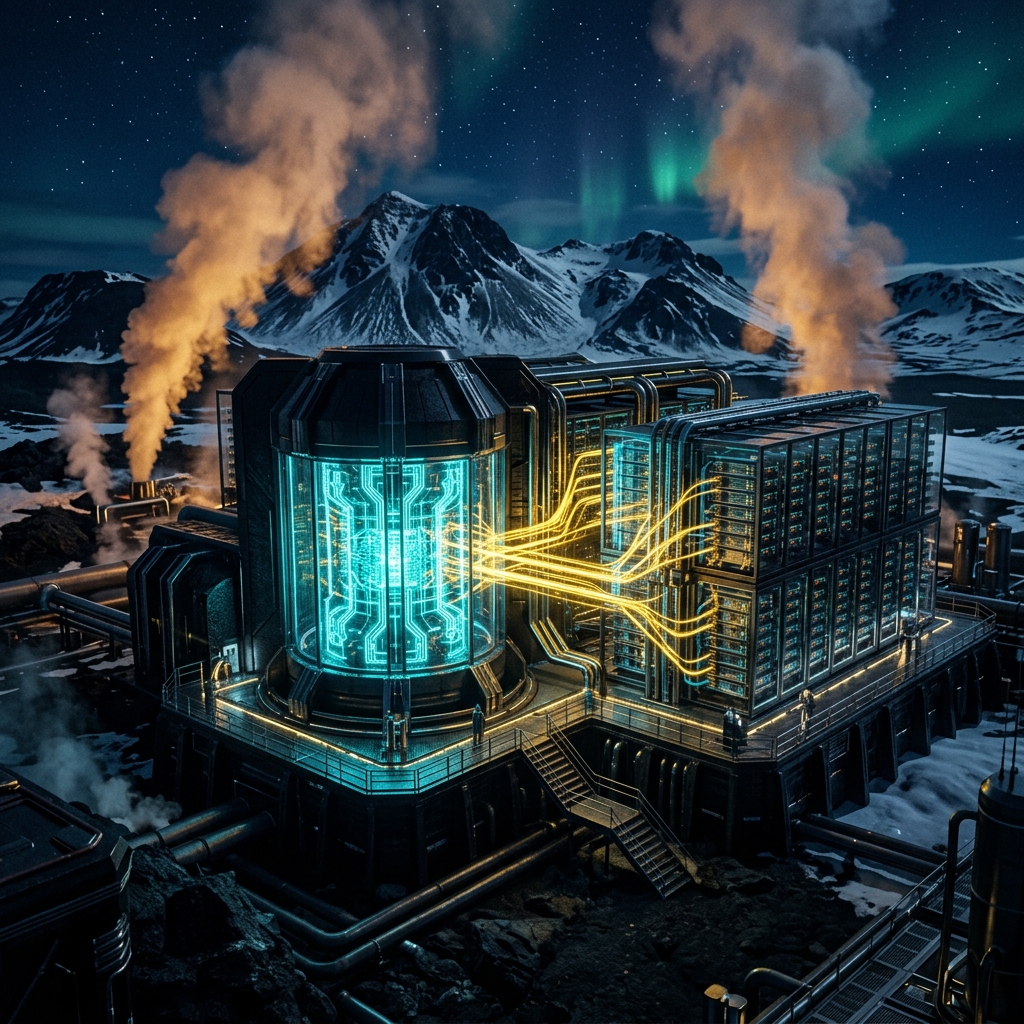
This trend is supported by policy measures, including Executive Orders that cap NRC application reviews at 18 months for advanced SMR designs. This creates localized computing corridors where reactors are built adjacent to server arrays, routing steam directly from the nuclear core to drive high-density cooling systems and establishing self-contained, sovereign computing zones.
03. The Failure of Traditional Monetary Policy Under Machine Capital#
The growth of the machine-to-machine (M2M) economy is driving a structural divergence between human-facing consumer markets and the automated machine economy. Traditional monetary policy assumes that a central bank can manage economic activity and inflation by adjusting short-term interest rates. This rate policy is transmitted through commercial banks, altering the cost of credit and influencing human consumption and investment:
This transmission channel relies on human actors, physical identity verifications, and traditional banking hours.
AI agents operating over decentralized ledgers bypass these traditional credit channels. In this space, the transaction medium has shifted toward machine-native assets, such as stablecoins (USDC) and resource tokens backed by physical energy (kWh) or compute capacity (FLOPS).
Because agents can evaluate and allocate capital across borders in milliseconds, they do not rely on traditional interbank credit. Instead, they fund operations using programmable wallets and smart contracts, streaming micro-payments in real time based on raw utilization.
The table below contrasts the economic and operational profiles of the human-facing fiat economy with the machine-native resource economy:
| Economic Attribute | Human-Centric Fiat Economy | Machine-Native Resource Economy |
|---|---|---|
| Primary Settlement Gateway | Centralized Commercial Banks & ACH Rails | Smart Contracts & Layer 2 Blockchains |
| Average Transaction Amount | Moderate to High (Standard retail spreads) | Micro-transactions ($0.31 to $0.48 averages) |
| KYC / Identity Paradigm | Passports, physical signatures, biometrics | Cryptographic DIDs and Verifiable Credentials |
| Settlement Finality | Multi-day settlement delays, business-hour limits | Real-time, instant atomic finality (24/7/365) |
| Transaction Fees | 2.0%−3.0%+$0.30 fixed processing fees | Sub-cent execution fees on Base/Solana |
| Velocity of Money (V) | Low velocity, bound by cognitive limits | Hyper-velocity (), executed at machine speeds |
This parallel monetary framework impacts the velocity of money (V) within the macroeconomic equation:
In the human economy, money velocity is limited by cognitive intervals, physical transaction interfaces, and banking cycles.
In the machine economy, programmatic velocity () is limited only by network latency and block times. Since AI agents can transact continuously without manual intervention, a single dollar of stablecoin collateral can be re-allocated thousands of times per day to capture localized compute-energy spreads.
This high velocity means that standard central bank balance-sheet adjustments are ineffective at curbing machine-driven resource demand. Even when a central bank raises interest rates to suppress credit expansion, the machine economy can maintain high transaction volumes as long as the computational yield per megawatt-hour remains profitable.
This has rendered Central Bank Digital Currencies (CBDCs) less effective in machine-native environments. Although some central banks view CBDCs (such as the Digital Yuan, or e-CNY) as programmable governance infrastructure for automated tax collection and fiscal transfers, CBDCs continue to rely on centralized sovereign oversight, lack unified cross-border interoperability, and face regulatory friction at national borders.
Consequently, the machine economy has adopted decentralized stablecoins like USDC as its default currency layer, integrated natively into the HTTP request cycle via the x402 protocol. By bypassing central bank gateways, machine capital establishes a self-contained economy where assets are priced in physical computation units rather than sovereign fiat debt.
04. Grid Vulnerabilities and Cascading Systemic Risk#
The integration of high-density computational clusters directly into electrical grids has turned localized energy transmission networks into high-frequency algorithmic environments. This shift is driven by the rise of volatile, weather-dependent renewable energy sources and the step-change load patterns of large AI data centers.
To manage electricity costs, data centers utilize on-site battery storage, backup generators, and microgrid management software to run continuous arbitrage between external grid power and local computing demands.
These dynamic interactions can create physical risks for weak distribution networks. AI computing centers behave primarily as power-electronics-interfaced loads rather than traditional inductive industrial demands.
When a massive GPU cluster transitions from an idle state to dense model execution (such as initiating a large-scale training run or experiencing a sudden spike in real-time inference), it can alter its power draw by 10 MW to 20 MW in less than one second.
These rapid load steps introduce severe voltage fluctuations (ranging from ±5% to ±10%) and harmonic distortions into the grid. The power electronics in server power supplies generate harmonics (specifically the 3rd, 5th, and 7th harmonics), pushing the Total Harmonic Distortion (THD) past the industry-standard 5% limit. This distortion degrades power quality, causing transformer overheating and disrupting nearby manufacturing equipment.
Grid disruptions can trigger cascading failures. During a voltage sag, the power-electronic interfaces and Uninterruptible Power Supply (UPS) systems in an AI data center may disconnect from the grid to protect sensitive silicon hardware.
In areas with high data center density, this sudden, uncoordinated load shedding can cause voltage swells and frequency spikes across the wider network. This creates a systemic risk of "sympathetic tripping," where the sudden disconnection of one facility increases the likelihood of cascading dropouts among neighboring computing centers, complicating recovery efforts.
To address these risks, regulators have introduced strict limits on automated energy transactions. In the European Union, the Agency for the Cooperation of Energy Regulators (ACER) enforces REMIT Article 15, which subjects algorithmic energy trading to direct regulatory oversight. This framework requires:
- ▸The implementation of pre-trade controls, automated kill switches, and strict trading limits to prevent erroneous order generation and artificial price inflation.
- ▸The formal registration of all trading algorithms with regional transmission operators.
- ▸The preservation of complete transaction and telemetry logs for a minimum of five years to assist in forensic audits of market anomalies.
In the United States, the Federal Energy Regulatory Commission (FERC) enforces reporting requirements to prevent market manipulation, such as algorithmic "spoofing" or "layering".
Despite these regulations, model risk remains high in automated energy trading. Most platforms (such as GridMind and ArbFlux) utilize forecasting models calibrated to historical data.
During extreme weather events or physical grid stress, price behavior can shift into scarcity pricing regimes where price formation is driven by grid balancing costs rather than standard marginal generation costs.
Under these conditions, algorithmic assumptions can break down, leading to rapid, uncoordinated energy bids that exacerbate grid instability or generate significant trading losses.
05. Research Modeling Toolkit: Autonomous Sovereign Microgrid Simulator#
To evaluate the operational decisions of an autonomous sovereign microgrid balancing localized computational assets against external grid export options, we construct a 24-hour mathematical decision-model.
Mathematical Formulation#
Let the total capacity of the sovereign microgrid be , with a baseline generation cost of . The system has two primary power allocation routes:
- ▸Onsite Server Array: A localized cluster with a maximum power capacity of .
- ▸Grid Connection: An external grid interconnection with a maximum export capacity of .
At any given hour , the allocation must satisfy the physical constraint:
The thermal efficiency of the server array is governed by its Power Usage Effectiveness (PUE), which degrades as ambient temperatures rise above the free-cooling threshold of :
Where is the baseline efficiency, and is the cooling degradation factor.
The microgrid operates under two real-world stress modifiers:
- ▸
Geopolitical Stress (): This factor models international trade friction, cyber-threats, or physical transmission risks. High stress levels increase the domestic value of computing power while penalizing the financial yield of grid exports due to transit tariffs or transmission friction:
- ▸
Compute Conversion Yield: Each megawatt of power routed to compute yields of active IT power. Every megawatt-hour of active IT power generates 10,000 PFLOPh of FP4 compute. Thus, the financial return of routing 1 MWh of power to the server array is:
The microgrid optimizer makes binary decisions based on marginal returns:
- ▸If , the system routes maximum capacity to compute () and exports the remaining balance ().
- ▸Otherwise, it prioritizes grid exports up to its interconnection limit ().
The hourly net margin is defined as:
24-Hour Simulation Analysis#
The model is tested under a 24-hour cycle featuring three events: an afternoon solar generation glut (nominal grid prices drop), a global computing congestion event between hours 12 and 18 (spiking token prices), and a high-risk geopolitical tension event between hours 14 and 16 ( peaking at 0.8).
The outputs of this simulation are summarized in the table below:
| Hour | Temp (°C) | Nominal Grid ($/MWh) | Effective Grid ($/MWh) | Effective Token ($/PFLOPh) | PUE | R_Comp ($/MWh) | Compute Load (MW) | Grid Load (MW) | FLOPs Generated (PFLOPh) | Net Hourly Profit ($/h) |
|---|---|---|---|---|---|---|---|---|---|---|
| 0 | 5.1 | 25.00 | 23.75 | 0.0172 | 1.100 | 156.82 | 80.0 | 20.0 | 727,272.7 | 11,020.45 |
| 1 | 4.3 | 25.68 | 24.40 | 0.0172 | 1.100 | 156.82 | 80.0 | 20.0 | 727,272.7 | 11,033.40 |
| 2 | 4.0 | 27.68 | 26.30 | 0.0172 | 1.100 | 156.82 | 80.0 | 20.0 | 727,272.7 | 11,071.36 |
| 3 | 4.3 | 30.86 | 29.31 | 0.0172 | 1.100 | 156.82 | 80.0 | 20.0 | 727,272.7 | 11,131.75 |
| 4 | 5.1 | 35.00 | 33.25 | 0.0172 | 1.100 | 156.82 | 80.0 | 20.0 | 727,272.7 | 11,210.45 |
| 5 | 6.3 | 39.82 | 37.83 | 0.0172 | 1.100 | 156.82 | 80.0 | 20.0 | 727,272.7 | 11,302.10 |
| 6 | 8.0 | 45.00 | 42.75 | 0.0172 | 1.100 | 156.82 | 80.0 | 20.0 | 727,272.7 | 11,400.45 |
| 7 | 9.9 | 50.18 | 47.67 | 0.0172 | 1.100 | 156.82 | 80.0 | 20.0 | 727,272.7 | 11,498.81 |
| 8 | 12.0 | 55.00 | 52.25 | 0.0172 | 1.100 | 156.82 | 80.0 | 20.0 | 727,272.7 | 11,590.45 |
| 9 | 14.1 | 59.14 | 56.19 | 0.0172 | 1.100 | 156.82 | 80.0 | 20.0 | 727,272.7 | 11,669.16 |
| 10 | 16.0 | 62.32 | 59.20 | 0.0172 | 1.115 | 154.71 | 80.0 | 20.0 | 717,488.8 | 11,560.77 |
| 11 | 17.7 | 29.32 | 27.85 | 0.0172 | 1.140 | 151.34 | 80.0 | 20.0 | 701,845.0 | 10,663.88 |
| 12 | 18.9 | 30.00 | 28.50 | 0.0230 | 1.159 | 198.46 | 80.0 | 20.0 | 690,296.0 | 14,446.81 |
| 13 | 19.7 | 29.32 | 27.85 | 0.0345 | 1.171 | 294.64 | 80.0 | 20.0 | 683,228.6 | 22,128.44 |
| 14 | 20.0 | 27.32 | 21.86 | 0.0720 | 1.175 | 612.77 | 80.0 | 20.0 | 680,851.1 | 47,458.40 |
| 15 | 19.7 | 24.14 | 14.49 | 0.1100 | 1.171 | 939.44 | 80.0 | 20.0 | 683,228.6 | 73,444.86 |
| 16 | 18.9 | 55.00 | 38.50 | 0.0855 | 1.159 | 737.75 | 80.0 | 20.0 | 690,296.0 | 57,790.31 |
| 17 | 17.7 | 140.18 | 133.17 | 0.0402 | 1.140 | 353.12 | 80.0 | 20.0 | 701,845.0 | 28,912.61 |
| 18 | 16.0 | 135.00 | 128.25 | 0.0288 | 1.115 | 257.85 | 80.0 | 20.0 | 717,488.8 | 21,192.80 |
| 19 | 14.1 | 129.82 | 123.33 | 0.0172 | 1.100 | 156.82 | 80.0 | 20.0 | 727,272.7 | 13,012.10 |
| 20 | 12.0 | 125.00 | 118.75 | 0.0172 | 1.100 | 156.82 | 80.0 | 20.0 | 727,272.7 | 12,920.45 |
| 21 | 9.9 | 120.86 | 114.81 | 0.0172 | 1.100 | 156.82 | 80.0 | 20.0 | 727,272.7 | 12,841.75 |
| 22 | 8.0 | 27.68 | 26.30 | 0.0172 | 1.100 | 156.82 | 80.0 | 20.0 | 727,272.7 | 11,071.36 |
| 23 | 6.3 | 25.68 | 24.40 | 0.0172 | 1.100 | 156.82 | 80.0 | 20.0 | 727,272.7 | 11,033.40 |
Simulation Insights and Behavioral Observations#
The 24-hour simulation illustrates the behavioral dynamics of autonomous resource allocation:
- ▸PUE Degradation vs. Computational Yield: As ambient temperatures rise during the afternoon (hours 10 to 16), peaking at 20.0 °C at hour 14, the microgrid's PUE degrades from its baseline of 1.100 to 1.175. This rise in PUE reduces the physical yield of computing power: at 1.100 PUE, 80 MW of input power generates 727,272.7 PFLOPh, whereas at 1.175 PUE (hour 14), the same power generates only 680,851.1 PFLOPh due to the increased thermal load.
- ▸Geopolitical Stress as a Revenue Multiplier: At hour 15, nominal compute token values are elevated due to global training congestion (0.0500 $/PFLOPh). Concurrently, geopolitical stress spikes to 0.8, which penalizes the effective grid export price by 50% (falling to $14.49/MWh) while boosting the effective local compute token value to $0.1100/PFLOPh. This drives the marginal return on compute () to $939.44/MWh. The system allocates its maximum 80 MW to compute, yielding a peak hourly net profit of $73,444.86. This confirms that geopolitical stress structurally enhances the premium on localized, sovereign compute havens.
- ▸Computational Inelasticity to Grid Spikes: At hours 17 and 18, human electricity demand causes nominal grid prices to spike to $140.18/MWh and $135.00/MWh. In traditional setups, an operator would curtail consumption to export power to the grid. However, because the marginal value density of compute remains elevated ( sits at $353.12/MWh at hour 17 due to residual compute demand), the microgrid continues to allocate its maximum 80 MW to compute.
This demonstrates that because computational yield per megawatt-hour is structurally superior to raw electricity export values, AI arrays are highly inelastic to standard grid pricing signals. This inelasticity can challenge grid stability unless operators utilize dedicated physical interconnect limits or negotiated demand-response tariffs.
06. Synthesis and Strategic Industry Framework#
The rise of the thermodynamic ledger and autonomous compute-energy arbitrage networks between 2027 and 2036 marks a shift in how value and sovereignty are measured. This evolution points to several key conclusions:
- ▸The Decoupling of the Machine Economy: Autonomous machine capital is establishing a parallel economy that operates independently of traditional central bank monetary policy. By transacting at high velocities via decentralized rails and pricing assets in physical resources (kWh and FLOPS), this economy bypasses traditional interest rate transmission channels.
- ▸The Valuation of Sovereign Compute Havens: Physical geography has re-emerged as a core driver of digital sovereignty. Nations with secure energy baseloads paired with natural cooling assets (such as Iceland, the UAE, or SMR-equipped regions in the US) are becoming centers of economic gravity, shifting the backing of sovereign currencies from debt toward physical compute efficiency.
- ▸Infrastructural Risks at the Grid Interface: High-density computational arrays introduce power quality and frequency challenges for regional utility grids. The step-change load patterns of massive GPU clusters require closer coordination between computing operators and utility providers.
07. Actionable Industry Recommendations#
To navigate these changes, systemic planners and technology leaders should consider several strategic actions:
For Utility and Transmission Grid Operators#
Implement targeted tariff structures that incentivize data centers to offer load flexibility. Rather than relying on price signals alone, operators should establish direct physical curtailment contracts and integrate behind-the-meter battery storage to buffer high-frequency load steps and prevent cascading grid tripping.
For Infrastructure Developers and Financial Institutions#
Align capital allocation with vertically integrated, energy-isolated compute assets. By investing in behind-the-meter nuclear, geothermal, or SMR-enabled microgrids, developers can secure long-term operating costs and protect assets from public grid volatility.
For Monetary Authorities and Central Banks#
Adjust macroeconomic risk models to account for the programmatic velocity of stablecoins and compute-denominated capital. Rather than attempting to control machine credit through traditional interbank interest rates, planners must focus on managing physical transmission bottlenecks, grid connections, and silicon supply chains as the primary policy levers of the machine economy.