The Lithospheric Engine: A Century-Forward Scientific Assessment of Advanced Geothermal Energy Extraction and Planetary-Scale Grid Integration
"The interior of the planet represents an inexhaustible, continuously replenished reservoir of thermal energy. Sovereignty in the post-transition era belongs to those who bypass atmospheric variables and tap the planetary core." — Sovereign Energy Division Briefing, Q2 2026
00. Transmission Header#
CLASSIFICATION : Tresslers Group Intelligence // Sovereign Energy Division
DOMAIN         : Strategic Infrastructure / Deep Geothermal / Materials Science
STATUS         : Active Strategic Intelligence — SOP v2.0 Validated
DATE           : 2026.06.07
LAST_SYNC      : 2026.06.07
PROTOCOL       : EGS / AGS / SHR / directed-energy MMW / CUSGER / HTS
AGENTIC_DELTA  : 89% (Lithospheric Abundance potential)
TPM_V1         : 96/100 (Sovereign Security Tier)
ALERT LEVEL    : Critical — Great power competition for deep earth drilling and grid supremacy
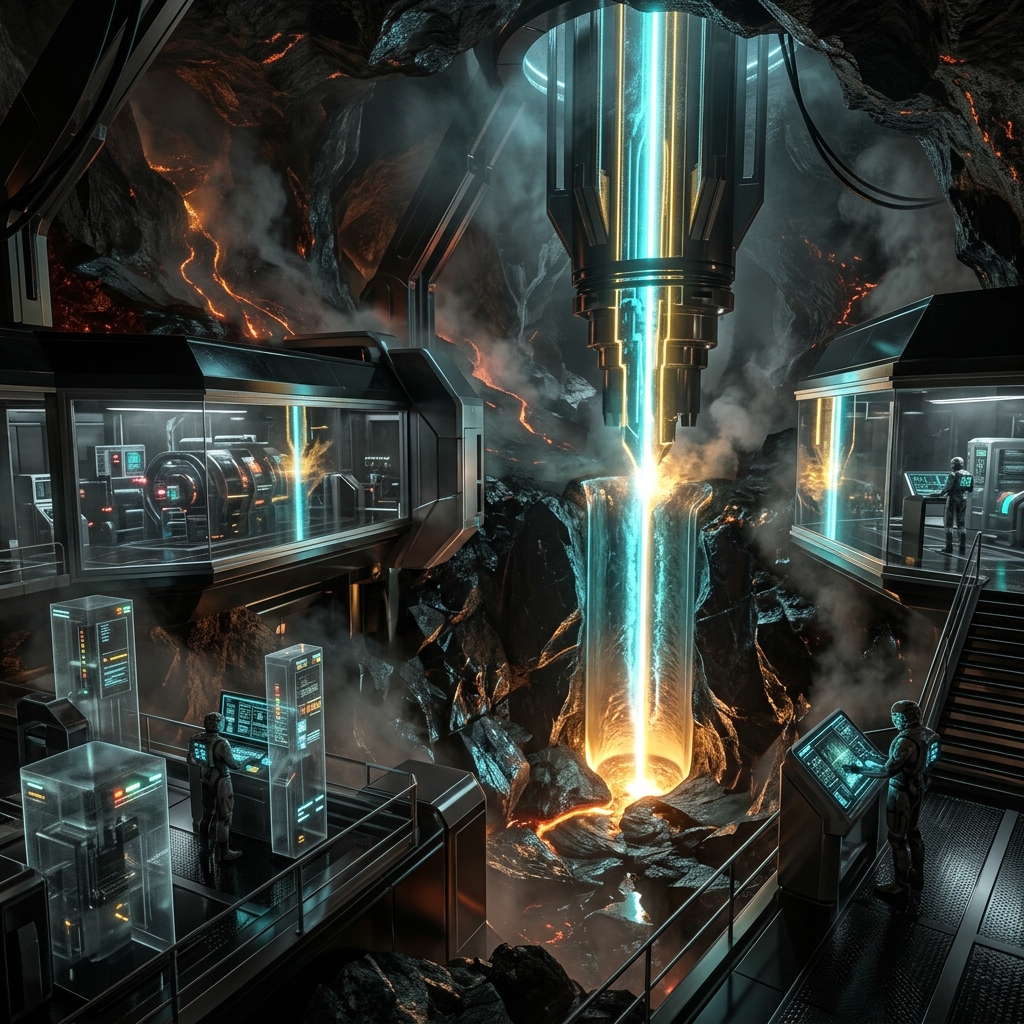
The interior of the planet represents an inexhaustible, continuously replenished reservoir of thermal energy, driven by the primordial heat of planetary accretion and the ongoing radioactive decay of isotopes within the mantle and crust. The Earth's core maintains temperatures approaching 5,000°C, establishing a continuous outward thermal flux that dictates the planet's geothermal gradient. In standard continental crust, this gradient typically ranges between 30°C and 35°C per kilometer of depth. For millennia, human utilization of this vast thermal engine has been restricted to surface anomalies—hot springs, geysers, and shallow hydrothermal reservoirs—where the Earth's crust naturally provides a triad of rare subterranean conditions: extreme heat, high rock permeability, and the presence of in-situ fluids to transport that heat to the surface.
The first commercial geothermal power generation facility, established in Larderello, Italy, in 1904, capitalized on naturally occurring dry steam. However, over a century later, geothermal energy remains a marginal contributor to the global energy mix, constrained almost entirely to tectonic plate boundaries and volcanic zones. The global energy paradigm is currently undergoing a structural transformation, shifting geothermal from a geographically localized resource into a universally accessible, baseload power solution. This shift is anticipated to yield profound environmental and economic benefits, with modeling suggesting that a transition to clean energy architectures, heavily supported by geothermal baseloads, could result in a total savings of $4.2 trillion in healthcare expenditures by 2030 and a reduction of 800 million metric tons of carbon dioxide emissions by 2050.
This comprehensive analysis examines the foundational technological shifts currently underway in geothermal energy extraction, moving from conventional hydrothermal systems to Enhanced Geothermal Systems (EGS), Advanced Geothermal Systems (AGS), and Superhot Rock (SHR) systems. Furthermore, it projects these trajectories 50 to 100 years into the future, theorizing a scientifically grounded landscape where humanity accesses the Earth's deepest lithospheric structures—including magmatic intrusions and the Mohorovičić discontinuity (Moho)—to establish a planetary-scale, superconducting global energy grid.
01. The Current Paradigm Shift: Engineered and Closed-Loop Systems#
Historically, geothermal power generation has relied on three distinct plant architectures. Dry steam plants utilize naturally occurring high-pressure steam to directly drive turbines. Flash steam plants extract high-pressure, high-temperature liquid water, rapidly decompressing it in surface tanks to flash it into steam. Binary cycle power plants, utilized for lower-enthalpy resources (typically between 85°C and 170°C), employ a heat exchanger to transfer thermal energy from the geothermal brine to a secondary working fluid with a lower boiling point, such as isobutane or pentane, which then drives the turbine. Because less than a fraction of the planet's surface exhibits the natural hydrothermal conditions required for these plants, the contemporary transition involves engineering the subsurface to create artificial reservoirs in hot, dry, and impermeable rock—a concept collectively known as petrothermal extraction.
02. Enhanced Geothermal Systems (EGS) and Shear Stimulation#
Enhanced Geothermal Systems (EGS) resolve the lack of natural permeability by applying advanced hydraulic stimulation techniques derived from the unconventional hydrocarbon sector. The objective is to create an artificial subterranean heat exchanger by fracturing hot crystalline basement rock. Unlike traditional oil and gas hydraulic fracturing, which seeks to create entirely new tensile fractures to drain a reservoir, EGS primarily operates through shear stimulation. High-pressure fluid is injected into the formation, causing pre-existing natural fracture networks to slip slightly along their fault planes. This shear displacement permanently increases the fracture aperture and permeability, allowing injected water to circulate efficiently between injection and production wells without creating unmapped fissures.
Recent commercial deployments have demonstrated the profound viability of this approach. Fervo Energy, an industry leader in EGS, has achieved massive cost and time reductions by adapting multi-stage horizontal drilling. By drilling vertically and then curving the wellbore to run horizontally, engineers can orient the well perpendicular to the natural stress field of the rock. For example, if the natural fracture networks tend to run east-west, the horizontal section is drilled north-south, ensuring that the maximum number of fractures intersect the wellbore.
Through the integration of Distributed Acoustic Sensing (DAS) utilizing downhole fiber optics, operators can detect micro-seismic events in real-time, mapping the exact three-dimensional propagation of the artificial fracture network as it forms. At their Project Red pilot in Nevada and the subsequent Cape Station production wells in Utah, Fervo achieved a 70 percent year-over-year reduction in drilling times while maintaining steady-state conditions at reservoir temperatures exceeding 220°C. Scientific literature surrounding these tests indicates record-breaking production rates for EGS, demonstrating steady-state circulation with highly manageable water loss rates of approximately 100 gallons per minute.
03. Advanced Geothermal Systems (AGS) and Thermosiphon Dynamics#
Where EGS relies on fracturing rock and circulating fluids directly through the geologic formation, Advanced Geothermal Systems (AGS) utilize entirely closed-loop architectures. These systems function as massive subterranean radiators. A continuous, sealed network of pipes—often forming a deep vascular or U-tube layout—is drilled into the hot rock. A working fluid is circulated through the closed loop, absorbing heat purely through conduction from the surrounding geology without ever physically interacting with the rock or native brines.
The closed-loop nature of AGS provides significant operational advantages. It eliminates the risk of induced seismicity associated with hydraulic fracturing and avoids the severe scaling, mineral deposition, and corrosion problems caused by highly saline geothermal brines. Furthermore, advanced designs increasingly explore the use of supercritical carbon dioxide (sCO2) rather than water as the internal working fluid. Supercritical CO2 exhibits strong thermosiphon properties; as it absorbs heat in the depths of the loop, its density drops precipitously, causing it to rise naturally to the surface. As it transfers heat to the surface power plant and cools, its density increases, causing it to sink back down the injection well. This creates a self-circulating loop that virtually eliminates the need for parasitic surface pumping power. The deployment of AGS represents a critical step in making geothermal energy completely independent of local hydrology, ensuring zero fluid loss to the formation and a negligible surface environmental footprint.
Table 1: Primary Characteristics of Geothermal Architectures#
| System Architecture | Permeability Source | Fluid Source | Environmental Interaction | Primary Application Range |
|---|---|---|---|---|
| Conventional Hydrothermal | Natural (High) | In-situ Brine | Open-loop, fluid extraction | Tectonically active regions |
| Enhanced Geothermal (EGS) | Artificial (Shear Stimulation) | Injected Water | Induced micro-seismicity | Hot Dry Rock (HDR) formations |
| Advanced Geothermal (AGS) | N/A (Conduction through pipe) | Sealed Working Fluid (H2O / sCO2) | Closed-loop, zero fluid contact | Low permeability, zero-water areas |
04. Breaking the Thermodynamic Ceiling: Supercritical and Superhot Rock (SHR) Systems#
While EGS and AGS expand the geographic footprint of geothermal energy, Superhot Rock (SHR) geothermal systems aim to fundamentally alter the thermodynamic efficiency and power output of individual geothermal wells. Traditional high-enthalpy geothermal wells typically access fluids at around 200°C to 300°C, producing approximately 5 Megawatts electric (MWe) per well. However, as the temperature and pressure of water increase progressively beneath the Earth's surface, the fluid dynamics change. Water becomes less dense while steam becomes denser until they reach the critical point—specifically 374°C and 22.1 MPa (221 bar) for pure water. Beyond this threshold, water enters a supercritical phase where the distinct boundaries between liquid and gas cease to exist, creating a single, uniform phase.
The Physics and Enthalpy of Supercritical Fluids#
Supercritical water is a radically different thermodynamic entity compared to subcritical fluids. At 400°C and supercritical pressures, water contains up to five times the specific enthalpy (heat energy) of liquid water at 200°C. Furthermore, it transfers thermal energy twice as efficiently and exhibits a substantially lower dynamic viscosity than standard liquid water, allowing it to flow out of the ground with drastically reduced frictional resistance.
The power generation potential of supercritical fluids is mathematically transformative. A feasibility study conducted in 2003 for the Iceland Deep Drilling Project (IDDP) calculated that, holding the volumetric inflow rate constant, a well tapping a supercritical reservoir at 450°C to 600°C could yield an order of magnitude increase in power output—producing up to 50 MWe from a single borehole. Harvesting SHR resources enables extreme energy densification; a major metropolis could theoretically be powered by merely three or four deep supercritical wells, drastically reducing the cumulative environmental surface footprint and the total capital expenditure associated with drilling hundreds of traditional wells.
05. The Iceland Deep Drilling Project (IDDP) and Magmatic Intersections#
The pursuit of SHR resources has transitioned from thermodynamic theory to active field experimentation. The IDDP, a consortium established in 2000 by Icelandic power companies and the National Energy Authority, was initiated to drill into the roots of volcanic systems to locate and assess supercritical regimes. In 2009, the IDDP-1 well was drilled in the Krafla volcanic caldera, an active rift zone in northeastern Iceland characterized by recent magmatic activity. The drilling unexpectedly intersected an unmapped rhyolitic magma intrusion at a depth of merely 2,100 meters.
The resulting fluid discharge from IDDP-1 possessed a temperature of 440°C and a specific enthalpy of ~3200 kJ/kg, representing the highest-enthalpy geothermal fluid ever captured. Geochemical modeling of these deeply sourced fluids indicates that their formation is heavily influenced by conductive heating of surrounding subcritical geothermal groundwater near the shallow intrusion. Isotope analysis of the fluids, particularly the lowest values observed in methane, suggests the presence of abiotic generation and superheated vapor equilibrium kinetics operating at the boundaries of the magmatic heat source. The calculations demonstrate that under temperatures exceeding 400°C, kinetic signals are erased rapidly, implying the rapid migration and quenching of methane into the overlying subcritical hydrothermal reservoirs.
Subsequent deep drilling efforts, such as the IDDP-2 well drilled in the Reykjanes field, involved deepening an existing 2.5-kilometer well. In early 2017, it reached a depth of 4,659 meters, successfully intersecting supercritical fluids at 427°C and a pressure of 340 bars. These field results definitively prove the existence of highly energetic supercritical reservoirs in the deep subsurface. Furthermore, historical drilling projects, such as the Soviet Kola Superdeep Borehole, which reached 12.26 kilometers, found that temperatures at depth were nearly twice as high as anticipated (180°C instead of 100°C) and discovered massive quantities of water chemically bound within the mineral structures of the deep granite. This revelation shattered previous geological assumptions, proving that aqueous fluids exist deep within the crystalline basement rock, primed to be flashed into supercritical states upon extraction.
06. Overcoming the Mechanical Impasse: Directed-Energy Drilling#
The primary bottleneck restricting universal access to SHR and deep geothermal resources is the physical limitation of mechanical drilling technology. The Earth's crust is highly asymmetrical in its physical properties; top sedimentary layers are relatively soft and easily penetrated, but the underlying crystalline basement rock (such as granite and basalt) is highly abrasive, dense, and possesses immense compressive strength.
Conventional rotary drilling relies on mechanical grinding using specialized drill bits, such as Polycrystalline Diamond Compact (PDC) bits. These mechanical components wear out rapidly in hot, hard rock, necessitating frequent, time-consuming, and expensive "tripping"—the process of pulling the entire drill string out of the multi-kilometer hole to replace the bit. Furthermore, conventional drilling relies entirely on "drilling mud"—a complex fluid pumped down the hollow interior of the drill pipe to cool the bit, transport rock cuttings to the surface, and provide critical hydrostatic pressure to prevent the borehole from collapsing inward.
However, at depths approaching 10 kilometers and temperatures exceeding 400°C, the chemical additives in drilling mud thermally degrade, and lubricants simply evaporate. The metallurgical properties of the high-grade steel drill string itself begin to soften and deform at temperatures above 300°C, leading to catastrophic downhole failures. These compounding inefficiencies cause the economic cost of mechanical drilling to rise exponentially with depth, typically placing a hard limit on boreholes at roughly 9 to 10 kilometers.
07. Millimeter-Wave (MMW) Gyrotron Vaporization#
To decouple geothermal drilling from the limitations of mechanical grinding and low-temperature fluid physics, researchers at the Massachusetts Institute of Technology (MIT), and subsequently the spin-out company Quaise Energy, have pioneered millimeter-wave (MMW) directed-energy drilling. This paradigm-shifting technology discards the physical drill bit entirely, replacing it with a high-power beam of electromagnetic energy capable of instantaneously melting and vaporizing ultra-hard crystalline rock.
The core of this directed-energy technology is the gyrotron, a high-powered linear-beam vacuum tube originally developed to heat plasma in nuclear fusion reactors. The gyrotron generates intense millimeter-wave electromagnetic radiation, operating in the high-frequency range of 30 to 300 GHz. These systems are remarkably efficient; gyrotron continuous wave (CW) output power levels of 1 Megawatt have been achieved with electrical-to-millimeter-wave power conversion efficiencies exceeding 50 percent.
The physical justification for using millimeter waves over standard far-infrared cutting lasers lies in the relationship between wavelength and particulate interference. Far-infrared lasers possess short wavelengths that scatter and attenuate severely when encountering plumes of vaporized rock and debris. Millimeter waves have wavelengths hundreds of times longer, allowing the MMW beam to propagate efficiently through visibly obscured paths and dense clouds of vaporized rock nanoparticles with minimal energy loss. This makes gyrotrons up to five times more energy-efficient at heating and melting deep rock than standard shorter-wavelength lasers.
08. The Process of In-Situ Vitrification#
The MMW drilling process operates as a highly optimized hybrid system. Conventional mechanical rotary rigs are utilized to efficiently drill through the softer sedimentary overburden until the ultrahard crystalline basement rock is reached. At this critical geological interface, the mechanical bit is withdrawn, and a continuous corrugated waveguide is inserted into the borehole. The gyrotron, positioned safely at the surface, fires a continuous wave of MMW energy down the waveguide.
As the directed energy impacts the rock at the bottom of the borehole, the extreme localized heating elevates the rock temperature past its melting point and into vaporization, displacing the solid matter entirely. A secondary, highly pressurized purge gas—typically clean argon or nitrogen—is pumped down the waveguide to clear the vaporized rock aerosols and transport them to the surface via an exhaust duct equipped with gas analysis monitoring and filtration units.
Crucially, the intense high-frequency thermal energy fundamentally alters the borehole walls. As the primary MMW beam vaporizes the central core of the rock, the peripheral heat partially melts the surrounding sidewalls. As the purge gas pushes the molten rock upward and outward, it cools and transforms into a permanent, glass-like obsidian liner. This process, known as in-situ vitrification, effectively cases the well as it is drilled. It seals off porous formations, provides immense structural rigidity to prevent borehole collapse at extreme depths, and eliminates the need to install costly steel casing and specialized cement in the deepest, hottest sections of the well.
Table 2: Comparative Limits of Geothermal Drilling Paradigms#
| Drilling Technology | Primary Penetration Mechanism | Primary Downhole Limitation | Maximum Functional Temperature | Borehole Stabilization Method |
|---|---|---|---|---|
| Conventional Rotary | Mechanical Grinding / Shearing | Drill bit wear, thermal mud degradation | ~250°C - 300°C | Steel Casing & Specialized Cement |
| Thermal Spallation | Exothermic chemical spallation | High rock stress requirements | ~400°C | Fluid Hydrostatics |
| MMW Gyrotron | Electromagnetic Rock Vaporization | Surface power requirement / Waveguide loss | >1000°C | In-Situ Vitrification (Glass Liner) |
The economic and strategic implications of MMW drilling are profound. By replacing the physical drill string with an electromagnetic wave, the exponential cost curve of deep drilling is flattened. Engineers project that this technology will routinely allow access to depths of 10 to 20 kilometers—environments where temperatures naturally reach 500°C, effectively unlocking supercritical geothermal resources anywhere on the planet regardless of tectonic boundaries. A primary commercialization strategy for this technology is the repurposing of soon-to-be-decommissioned coal and natural gas power plants. By drilling deep, localized SHR loops directly on the footprint of these legacy facilities, operators can swap out the fossil-fuel boilers and feed clean supercritical steam directly into the plant's existing turbines, utilizing the established electrical grid connections.
09. Extreme Downhole Electronics and High-Temperature Materials Science#
Exploiting SHR resources at depths of 10 to 20 kilometers introduces extreme engineering challenges for the downhole measurement tools, telemetry electronics, and metallurgical integrity of the wellbore casing. In standard hydrocarbon extraction, downhole telemetry relies on conventional silicon-based semiconductors, which become entirely non-functional at temperatures above 300°C.
The Wide-Bandgap Semiconductor Revolution#
The failure of standard electronics at high temperatures is rooted in solid-state physics. In a semiconductor, thermal energy can excite electrons from the valence band across the bandgap into the conduction band, generating intrinsic charge carriers. As temperatures exceed 300°C in standard silicon (which has a relatively narrow bandgap of ), the thermal generation of intrinsic carriers overtakes the controlled concentration of dopant carriers. This causes p-n junctions to leak uncontrollably, leading to total device failure and loss of computational integrity.
To operate in the 500°C to 600°C environments required for SHR logging and telemetry, the geothermal industry is shifting entirely to wide-bandgap (WBG) semiconductors, specifically 4H-Silicon Carbide (4H-SiC). With a highly stable energy bandgap of approximately 3.26 eV, 4H-SiC possesses an intrinsic carrier concentration negligible enough to maintain functional p-n junctions even at extreme thermal loads.
Recent advancements have demonstrated the viability of highly complex analog and mixed-signal integrated circuits (ICs) fabricated on 4H-SiC substrates. Researchers have successfully designed and characterized fully-differential Operational Amplifiers, junction field-effect transistors (JFETs), and continuous-time sigma-delta modulators capable of sustained operation at 500°C. At these temperatures, fabricated 4H-SiC p-n diode temperature sensors display highly stable linear sensitivities of up to 4.7 mV/°C across a massive temperature range from 17°C to 600°C. Furthermore, planar-integrated diode bridge rectifier circuits operate with up to 89.1% voltage conversion efficiencies at 500°C.
By integrating these robust SiC components, operators can deploy uncooled, long-duration telemetry tools into SHR wells to monitor pressure, micro-seismic activity, and fluid chemistry in real-time. For extremely sensitive electronic components that cannot be transitioned to SiC, engineers employ localized active downhole cooling utilizing thermoelectric Peltier elements housed within vacuum-insulated Dewar flasks to maintain strict internal thermal margins.
10. Extreme Metallurgy in Supercritical Regimes#
The geochemical environment within an SHR well is highly aggressive and dynamic. As temperatures and pressures cross the supercritical threshold, the dissociation constants of ionic species shift drastically. Deep geothermal brines frequently contain high concentrations of dissolved carbon dioxide (), hydrogen sulfide (), and complex chlorides. During periods of pressure reduction or subcritical condensation within the wellbore, compounds such as hydrogen chloride () dissociate rapidly. While supercritical fluids can exhibit near-neutral behavior, the condensed subcritical liquid drops in pH precipitously, creating highly localized acidic environments with pH values as low as 2 or 3.
Conventional carbon steel casings (such as API K55) experience catastrophic general and localized corrosion, as well as severe creep deformation and a massive loss of tensile strength, under 500°C conditions. Corrosion rate distributions indicate that metallic degradation maximizes in the subcritical regions between 300°C and 350°C, particularly during the temperature recovery period after drilling.
To maintain multi-decade well integrity, metallurgical research has focused on the deployment of advanced Titanium alloys and high-nickel superalloys (such as Inconel UNS N06625). Specifically, novel titanium alloys with nominal compositions of Ti-0.4Ni-3.6Mo-0.75Zr have been engineered specifically for SHR environments. The addition of Zirconium enhances both the mechanical stability of the -phase (body-centered cubic) titanium lattice and its high-temperature tensile strength, while Molybdenum and Nickel support the rapid formation of a highly stable, self-healing protective titanium dioxide () passive film.
Autoclave testing simulating the superheated and highly acidic conditions of the IDDP-1 Krafla well indicates that these titanium-based casing materials exhibit outstanding resistance to localized pitting and under-deposit corrosion. In field applications such as the Salton Sea, titanium casings have operated for over 15 years with no loss of production due to corrosion. Furthermore, to mitigate the extreme capital expenditure of deploying solid titanium casings, the industry is advancing Extra High-speed Laser Application (EHLA) cladding. This additive manufacturing process metallurgically bonds a thin layer of titanium or superalloy directly to the inner diameter of conventional steel casing, providing identical chemical resistance at a fraction of the cost. Additionally, chemical mitigation strategies, such as injecting caustic sodium hydroxide (NaOH) at the wellhead, are utilized to neutralize acidic condensates and control localized corrosion.
Table 3: Metallurgical Performance of Casing Materials in Geothermal Wells#
| Casing Material | Primary Vulnerability | Performance at 350°C (Subcritical) | Performance at >450°C (Supercritical) | Estimated Cost Factor |
|---|---|---|---|---|
| Carbon Steel (K55) | HCl condensation, low pH | Severe general and pitting corrosion | Loss of tensile strength, creep | Baseline (1x) |
| Inconel (UNS N06625) | Under-deposit corrosion | High resistance, minor localized pitting | Excellent mechanical stability | Very High (10x+) |
| Titanium Alloy (Ti-Zr) | Halide embrittlement | Exceptional passivity via TiO2 | High tensile retention | High (8x) |
| EHLA Clad Steel | Cladding delamination | High resistance (matches cladding material) | Dependent on base steel integrity | Moderate (3x) |
11. The Marine Frontier: Mid-Ocean Ridges and the Moho Discontinuity#
While continental SHR drilling seeks to reach 10 to 20 kilometer depths, the Earth's offshore environments offer a geologically shorter and vastly more energetic pathway to extreme temperatures. The Earth's crust is highly asymmetrical; while continental crust averages 35 kilometers in thickness (expanding up to 90 kilometers under mountain ranges), the oceanic crust is dramatically thinner, averaging only 5 to 10 kilometers.
Tapping the Mohorovičić Discontinuity#
The distinct boundary separating the Earth's crust from the underlying highly ductile lithospheric mantle is known as the Mohorovičić discontinuity, commonly referred to as the Moho. Discovered in 1909 by Croatian seismologist Andrija Mohorovičić, the Moho is defined by the sudden, dramatic change in the velocity of seismic waves. Primary seismic waves (P-waves) traveling through basaltic oceanic crust average velocities of 6.7 to 7.2 km/s; upon crossing the Moho into the peridotite-rich mantle, these velocities spike to 7.6 to 8.6 km/s, marking the transition into the planet's primary thermal reservoir.
Along divergent tectonic boundaries, specifically the submarine mid-ocean ridge systems, upwelling magma from the asthenosphere brings the Moho and its associated extreme heat to uniquely shallow depths. In these oceanic rift zones, the core-mantle heat flux drives massive natural hydrothermal circulation, visibly manifesting as "black smoker" hydrothermal vents that discharge supercritical water directly onto the seafloor. Offshore drilling at these mid-ocean ridges allows access to supercritical geothermal resources at drill depths of merely 2,000 to 2,500 meters beneath the seafloor, penetrating hard basalt rather than deep continental granite.
The CUSGER Framework and Submarine Resource Extraction#
Exploiting the intense thermal energy of mid-ocean ridge systems is not limited strictly to electricity generation. These highly active submarine calderas are hosts to Volcanogenic Massive Sulfide (VMS) deposits, which accumulate in discordant, pipe-like geometries and are incredibly rich in critical metals, largely copper, zinc, lead, and gold. The intersection of advanced offshore drilling and ocean-floor geothermal extraction has birthed the theoretical, yet highly actionable, framework of CUSGER: Combined Use of Supercritical Geothermal Energy Resources.
A CUSGER platform operating above a mid-ocean ridge would deploy a closed-loop or EGS network into the shallow, highly permeable basaltic crust. The virtually unlimited supply of highly pressurized, cold oceanic water serves as an ideal injection fluid, entirely eliminating the water-scarcity constraints often faced by continental EGS projects in arid regions. The supercritical fluid returned to the ocean-surface platform would drive highly efficient supercritical Brayton-cycle turbines to generate massive baseload electricity.
Because transmitting raw electricity from remote mid-ocean ridges to continental landmasses presents immense logistical and electrical engineering challenges, the primary power output would be utilized locally on the floating platform to drive supercritical high-temperature electrolysis, splitting seawater into green hydrogen and oxygen. Simultaneously, the thermal energy and high-volume brine circulation would be routed through chemical separation facilities to extract valuable VMS minerals and lithium, effectively turning the offshore geothermal platform into an integrated energy, fuel, and mining nexus.
12. A Century-Forward Projection: The Sci-Fi Grounded Reality (2075–2125)#
Extrapolating the current trajectories of millimeter-wave gyrotron drilling, high-temperature SiC electronics, supercritical thermodynamics, and offshore CUSGER systems allows for a rigorous, science-based projection of the global geothermal landscape 50 to 100 years into the future. The late 21st and early 22nd centuries will likely witness the complete decoupling of human energy production from fossil fuels, atmospheric variables, and geographic constraints, unifying the global power supply through deep-earth thermal dynamics.
Ubiquitous Superhot Rock Access and Direct Magmatic Heat Extraction#
By the 2080s, the maturation of directed-energy drilling will render the concept of geothermal "hotspots" obsolete. With the capability to vaporize crystalline rock to depths of 20 kilometers at a linear and highly predictable economic cost, EGS and AGS operators will drill directly beneath global megacities, providing immense baseload power exactly where the electrical load is highest.
As deep-drilling technology crosses the 20-kilometer threshold and interfaces directly with the Moho or shallow magmatic intrusions, conventional steam-turbine thermodynamics will face mechanical efficiency plateaus. In the 22nd century, the extraction of energy directly from molten rock (magma) will transition from theoretical models to operational reality. Magma temperatures ranging from 700°C to 1,600°C will be harnessed not by boiling water, but through the use of highly specialized closed-loop systems circulating liquid metals (such as liquid sodium or potassium) or ionized inert gases.
Magnetohydrodynamic (MHD) Power Generation#
At the extreme temperatures provided by direct magmatic contact, thermal energy can be converted to electricity entirely without moving mechanical parts utilizing Magnetohydrodynamic (MHD) power generation. The principle of MHD generation relies on the dynamics of electrically conducting fluids intersecting electromagnetic fields.
In a closed-cycle MHD generator, the superheated liquid metal or conductive plasma, heated directly by the magmatic intrusion, is forced at extremely high velocity through a channel intersecting a powerful, superconducting magnetic field. According to Faraday’s law of electromagnetic induction, the movement of this highly conductive fluid across the magnetic field directly induces an electromotive force (EMF). This induces a direct electrical current that is collected by electrodes lining the channel.
The integration of direct magmatic heat with closed-cycle MHD generation will push thermal-to-electrical conversion efficiencies far beyond the theoretical thermodynamic limits of the standard Rankine or Brayton cycles utilized today. Because there are no spinning turbines or mechanical wear components in the high-heat zone, MHD generators driven by liquid metals are uniquely suited to the extreme thermal loads of magmatic geothermal extraction, providing unparalleled longevity and power density.
The Global Superconducting Grid#
The ultimate manifestation of a mature, planetary geothermal civilization will be the construction of a globally interconnected electrical supergrid. Areas with naturally shallow Moho depths, such as the mid-ocean ridges, the Great Rift Valley, and the Krafla caldera, will produce electrical surpluses vastly exceeding local or even regional requirements. To transport this immense baseload power from the deep oceans and hyper-productive SHR hubs to global load centers, traditional Alternating Current (AC) transmission networks will be entirely replaced by High-Voltage Direct Current (HVDC) architectures.
By the turn of the 22nd century, these intercontinental HVDC grids will utilize high-temperature superconducting (HTS) materials rather than conventional copper or aluminum cables. Superconducting cables, maintained below their critical temperature thresholds (e.g., 77 Kelvin, easily achieved using liquid nitrogen cooling jackets), exhibit exactly zero electrical resistance. Although they require refrigeration, the total energy losses from refrigeration are less than half those of conventional AC and DC overhead lines. This zero-resistance property allows for the transmission of gigawatts of power across thousands of kilometers—from a floating mid-ocean CUSGER platform in the Atlantic to the heart of Europe, or from an Australian deep-geothermal array into the Southeast Asian supergrid—with essentially zero transmission loss.
The integration of a global superconducting grid fed by continuous, unvarying SHR and magmatic geothermal power resolves the final, and most persistent, barrier of the renewable energy transition: intermittency. While solar and wind generation remain fundamentally reliant on chaotic atmospheric variables and require massive, resource-intensive chemical battery energy storage systems (BESS), a global geothermal supergrid acts as a planetary-scale, self-balancing baseload. If a sudden surge in demand occurs in one hemisphere, or a localized weather event disables surface solar arrays, the instantaneous, zero-resistance nature of the superconducting grid allows geothermal energy to be dynamically re-routed from off-peak production zones in the opposing hemisphere.
Future iterations of this network, conceptualized as the Hydrogen-Electric Energy SuperGrid, envision continent-wide underground HVDC networks where the superconducting cables carry electricity, while liquid hydrogen is pumped through the same conduit to cool the cable. The hydrogen provides immense daytime energy storage for leveling consumption peaks, while the electricity provides the continuous power, creating a fully unified, zero-carbon energy distribution architecture.
Table 4: Projected Century-Forward Geothermal Energy Infrastructure Milestones#
| Technological Era | Primary Geothermal Target | Drilling Modality | Primary Energy Conversion | Grid Architecture |
|---|---|---|---|---|
| Current (2020s) | Hydrothermal / Shallow EGS | Mechanical Rotary (PDC Bits) | Rankine Cycle / Binary Steam | Regional AC / Localized DC |
| Near-Future (2050s) | Superhot Rock (SHR) 400°C+ | Hybrid / MMW Gyrotron Intro | Supercritical Brayton Cycle | Continental HVDC Networks |
| Long-Term (2100+) | Magma / Moho Discontinuity | MMW Vaporization / Plasma | Magnetohydrodynamic (MHD) | Global Superconducting (HTS) |
13. Conclusion: The Earth as a Programmable Battery#
Geothermal energy represents the ultimate synthesis of planetary geophysics and human engineering. The limitations that historically marginalized geothermal power—specifically the strict geographic necessity for natural in-situ fluids and highly permeable geology—are being methodically and permanently dismantled. Through the application of precision shear-stimulation in Enhanced Geothermal Systems, and the total isolation mechanics of Advanced Geothermal closed-loops, humanity is actively learning to artificially replicate, control, and optimize the subterranean environment.
The true future of energy abundance, however, lies in breaking absolute physical barriers. Reaching the highly energetic supercritical regimes demonstrated by the IDDP requires drilling through the hardest rocks on Earth to depths where conventional machinery literally melts and deforms. The introduction of millimeter-wave gyrotron drilling effectively weaponizes electromagnetic physics to vaporize these barriers, transforming an exponential economic cost-curve into a predictable linear one, while simultaneously vitrifying the wellbore to ensure structural integrity at extreme depths. Paired with the advent of wide-bandgap 4H-SiC semiconductors and advanced titanium-zirconium metallurgy, operators will soon possess the computational, sensory, and structural capabilities required to fully domesticate the 500°C+ lithospheric abyss.
Looking forward to the dawn of the 22nd century, the Earth's crust will no longer be viewed as an impenetrable geological barrier, but rather as an infinite, highly programmable thermal battery. The synergistic combination of offshore mid-ocean ridge extraction, localized petrothermal drilling at legacy power plants, and direct magmatic MHD generation will provide a practically limitless supply of zero-carbon, high-density baseload electricity. Delivered across continents and oceans via zero-loss high-temperature superconducting grids, deep geothermal energy possesses the scientific mandate and the thermodynamic potential to permanently resolve the global energy equation, securing an era of absolute energy abundance driven entirely by the power of the planetary core.
References & Source Intelligence#
- ▸Montel. (2025). What Is Geothermal Energy? [montel.energy]
- ▸Star Energy Group. (2025). What is Geothermal? [starenergygroupplc.com]
- ▸ResearchGate. (2025). Enhanced Geothermal Systems: A Critical Review of Recent Advancements and Future Potential for Clean Energy Production.
- ▸Wikipedia. Mohorovičić discontinuity. [en.wikipedia.org]
- ▸Global Energy Network Institute (GENI). Let's Build a Global Power Grid. [geni.org]
- ▸Information Technology and Innovation Foundation (ITIF). (2024). Advanced Geothermal Energy Is Widely Available, Clean, and Carbon-Free.
- ▸Lawrence Berkeley National Laboratory. (2025). Enhanced Geothermal Systems: A Promising Source of Round-the-Clock Energy. [newscenter.lbl.gov]
- ▸Stanford Geothermal Program. (2024). Alternative Design Concept for Enhanced Geothermal Systems Through Reconfiguration of Stimulation Techniques from the Past. [pangea.stanford.edu]
- ▸ResearchGate. (2024). Closed-loop geothermal systems: Modeling and predictions.
- ▸EarthDate. (2024). Iceland, the Geothermal Pioneer. [earthdate.org]
- ▸ThinkGeoEnergy. (2025). Supercritical water could spur geothermal revolution. [thinkgeoenergy.com]
- ▸Iceland Deep Drilling Project (IDDP). The concept of the Iceland deep drilling project. [moodle2.units.it]
- ▸Massachusetts Institute of Technology (MIT). (2022). Rock, drill bit, microwave: Paul Woskov explores a new path through the Earth's crust. [news.mit.edu]
- ▸Quaise Energy. (2024). Quaise begins testing of potentially disruptive geothermal drilling technology. [quaise.com]
- ▸U.S. Patent US8393410B2. Millimeter-wave drilling system. [patents.google.com]
- ▸Diva-Portal. (2024). Silicon Carbide Sigma-Delta Modulator for High Temperature Applications. [diva-portal.org]
- ▸UC Berkeley EECS. Harsh Environment Silicon Carbide Metal-Semiconductor Field-Effect Transistor. [www2.eecs.berkeley.edu]
- ▸MDPI. (2024). Corrosion Behaviour of Titanium Alloy and Carbon Steel in a High-Temperature, Single and Mixed-Phase, Simulated Geothermal Environment Containing H2S, CO2 and HCl. [mdpi.com]
- ▸Electric Power Research Institute (EPRI). Corrosion of Materials Used in Geothermal Power Production. [restservice.epri.com]
- ▸Incorporated Research Institutions for Seismology (IRIS). Layers of the Earth—What is the Moho? [iris.edu]
- ▸Oil & Gas Portal. Supercritical Geothermal Resources: Exploration. [oil-gasportal.com]
Tresslers Group Intelligence, Sovereign Energy Division Driven by Innovation. Defined by Impact. Absolute Geologic Sovereignty. © 2026 Tresslers Group. Transmission Complete.
14. Decision-Maker's Delta (DMD)#
Immediate Imperatives (0–6 Months)#
- ▸Drilling Technology Audit: Conduct immediate evaluation of MMW gyrotron drilling waveguides and source 1 Megawatt CW output gyrotrons for initial test pads.
- ▸Metallurgical & Sensor Supply-Chain Review: Audit and source qualified suppliers of 4H-SiC integrated circuits and Ti-0.4Ni-3.6Mo-0.75Zr alloy casings to shield deep boreholes from high-enthalpy corrosion.
Strategic Horizon (6–24 Months)#
- ▸Coal Plant Infrastructure Siting: Map legacy coal and gas facilities currently scheduled for decommissioning to prepare horizontal multi-lateral pads for Superhot Rock deep loops.
- ▸Offshore CUSGER Consortium: Draft joint-venture frameworks with marine engineering groups to secure mineral exploration leases at submarine divergent boundaries.
Tactical Response#
- ▸Shear Stimulation Telemetry: Implement Distributed Acoustic Sensing (DAS) fibers in existing EGS pads to monitor fracture propagation and control micro-seismicity thresholds.
- ▸Thermosiphon Loop Prototyping: Build closed-loop simulation loops utilizing supercritical carbon dioxide (sCO2) to validate self-circulating convective dynamics.